What Are State & Government Projects in the Scaffold & Access Context?
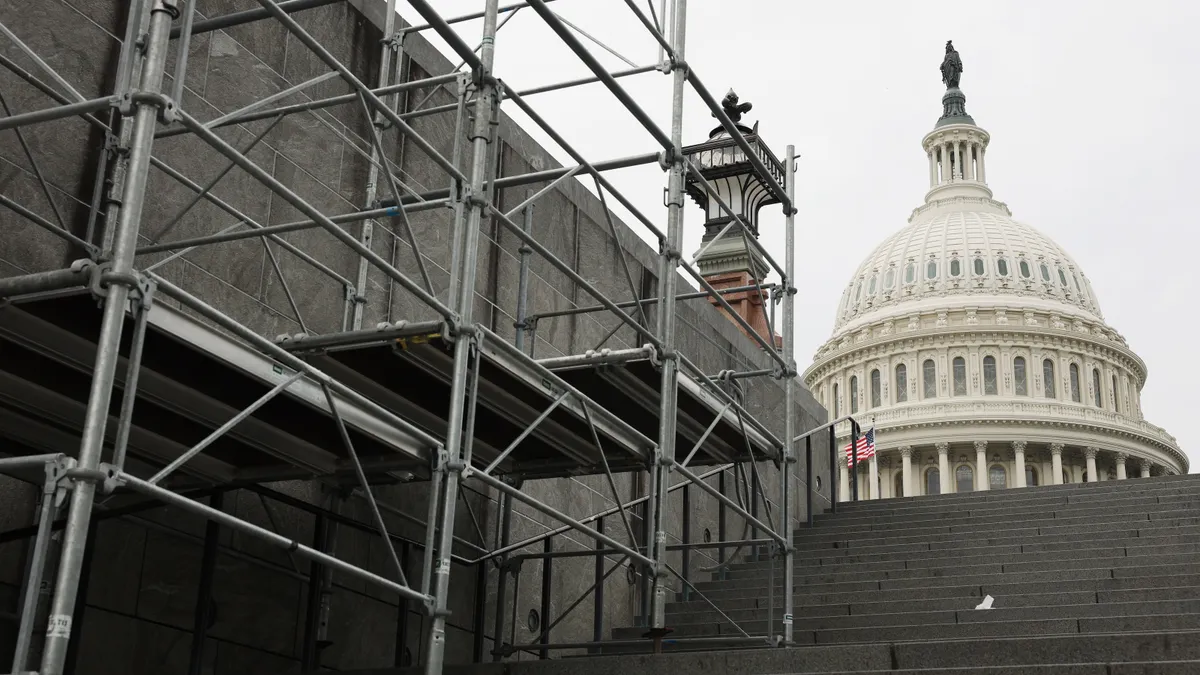
Definition: State and government projects — in the scaffold and access context — encompass scaffold provision for construction, renovation, and maintenance work commissioned by federal, state, county, or municipal government agencies on publicly owned or publicly funded facilities, including courthouses and government office buildings, public schools and universities, military installations and defense facilities, public housing developments, transportation infrastructure such as bridges and transit facilities, correctional facilities, and other civic buildings. Government scaffold procurement is governed by formal public procurement regulations that differ substantially from private sector contracting — competitive sealed bidding or formal request-for-proposal processes with publicly documented evaluation criteria, mandatory prevailing wage requirements under the Davis-Bacon Act for federally funded projects (and equivalent state prevailing wage laws for state-funded work), specific contractor qualification and bonding requirements, and extensive compliance documentation obligations that exceed typical private sector contracting standards.
The procurement formality of government scaffold contracting reflects the public accountability requirements that govern the expenditure of taxpayer funds — government agencies must demonstrate that contractor selection was conducted through a fair, documented, and defensible process, that contractors meet minimum qualification standards including insurance, bonding, and safety performance criteria, and that the work is performed in compliance with prevailing wage laws that require contractors to pay locally determined wage rates for the specific trade classifications involved in the work. Scaffold contractors pursuing government work must be prepared to navigate this procurement formality — including formal bid submission requirements, contractor registration and certification processes (such as federal SAM.gov registration for federal contracts), and the bonding and insurance documentation that government contracts typically require at levels exceeding private sector norms.
Government scaffold projects span an enormous range of scale and building type — from a small municipal building's exterior maintenance scaffold to major federal facility construction or military installation infrastructure programs — and many specific government project types overlap with other categories on Scaffold Exchange: public housing renovation shares characteristics with the Residential Clients and Renovation Projects categories but with HUD funding compliance requirements layered on top; government office building renovation shares characteristics with Commercial Projects; and major infrastructure programs may fit the Capital Projects delivery model. The distinguishing feature across all these overlaps is the public procurement framework and prevailing wage compliance obligation that government funding imposes regardless of the specific building type or renovation scope. Through Scaffold Exchange, you can find scaffold vendors near you with government contracting experience and compare their certifications, bonding capacity, and public sector track record.
How Scaffold Is Delivered on State & Government Projects
Government scaffold procurement follows a formal, documented sequence shaped by public procurement regulations, from contractor registration through bid submission, award, and compliance-documented execution.
Contractor Registration & Qualification
Scaffold contractors pursuing government work typically must complete registration processes specific to the funding source — federal SAM.gov registration for federal contracts, state-specific vendor registration systems for state-funded work — and demonstrate qualification criteria including insurance coverage, bonding capacity, safety performance history, and any specific certifications the procuring agency requires. This registration and qualification process should be completed well before a specific bid opportunity arises, since the registration timeline itself can take weeks to complete.
Formal Bid Submission & Award
The scaffold scope is competitively bid through the procuring agency's formal solicitation process — sealed bid, request for proposal, or an equivalent formal procurement method depending on the agency and contract value — with bids evaluated against publicly documented criteria including price, technical capability, and compliance with bonding and insurance requirements. The award is made through a formal, documented process that the agency must be able to defend if challenged, distinguishing government procurement from the more flexible negotiated procurement common in private sector contracting.
Prevailing Wage & Compliance-Documented Execution
During project execution, the scaffold contractor pays prevailing wage rates determined for the specific trade classifications and project location under the Davis-Bacon Act (federal projects) or the applicable state prevailing wage law, maintains certified payroll records documenting compliance, and complies with any additional security, site access, or facility-specific protocols the government facility requires — particularly significant on military installations, correctional facilities, and other security-sensitive government sites.
Documentation Close-Out & Compliance Audit
At project completion, the scaffold contractor submits the compliance documentation the contract requires — certified payroll records, safety inspection documentation, and any other reporting the procuring agency specifies — and the project is subject to potential compliance audit given the public funding source. Government contracts frequently retain documentation requirements and audit rights for a defined period after project completion, longer than typical private sector contract close-out obligations.
Key Scaffold Considerations for State & Government Projects
Government scaffold contracting introduces procurement formality, wage compliance, and security considerations that distinguish it from private sector scaffold procurement regardless of the specific building type.
Formal Competitive Procurement
Government scaffold contracts are typically awarded through formal competitive bidding or request-for-proposal processes with publicly documented evaluation criteria, distinct from the more flexible quotation and negotiation processes common in private sector scaffold procurement. Scaffold contractors must understand and be prepared to navigate the specific procurement process of each procuring agency.
Prevailing Wage Compliance
Federally funded projects require Davis-Bacon Act prevailing wage compliance — paying locally determined wage rates for each trade classification involved in the work — and state-funded projects are frequently subject to equivalent state prevailing wage laws. Contractors must maintain certified payroll records documenting compliance and should price their bids reflecting the prevailing wage rate rather than their standard market rate, which can be significantly different in some markets.
Bonding & Insurance Requirements
Government contracts frequently require performance bonds, payment bonds, and insurance coverage levels exceeding typical private sector norms — protecting the public agency's interest in contract performance and protecting subcontractors and suppliers in the event of contractor default. Scaffold contractors must confirm their bonding capacity is sufficient for the specific contract value before bidding.
Security & Facility Access Protocols
Military installations, correctional facilities, courthouses, and other security-sensitive government buildings impose specific personnel background check, security clearance, and facility access protocols that scaffold crews must complete before site access, in addition to standard safety orientation requirements — adding lead time to project mobilization that should be planned for explicitly.
Compliance Documentation & Audit Readiness
Government contracts require extensive compliance documentation — certified payroll, safety inspection records, contract performance reporting — and remain subject to audit rights extending beyond typical private sector contract close-out periods, requiring scaffold contractors to maintain organized, retrievable records well after project completion.
Overlap with Building-Type Categories
Many specific government project types overlap with other Scaffold Exchange industry categories — public housing renovation shares scope with Residential Clients and Renovation Projects, government office renovation shares scope with Commercial Projects, and major infrastructure programs may fit the Capital Projects delivery model — with the public procurement and prevailing wage framework layered on top regardless of the underlying building type.
Common Government Project Types Using Scaffold
Scaffold supports government construction and renovation across the full range of public facility types, each subject to the public procurement and compliance framework distinctive to government contracting.
Courthouse and government office building renovation — facade restoration and interior renovation of federal, state, and municipal government facilities
Public school and university construction and renovation — K-12 and higher education facility construction funded through state and local education capital programs
Military installation construction and maintenance — defense facility construction and infrastructure maintenance requiring military base security clearance
HUD-funded public housing renovation — federally funded residential renovation programs requiring HUD compliance and licensing standards for lead abatement and other regulated work
Bridge and transportation infrastructure projects — state and federal department of transportation funded bridge rehabilitation and transit facility construction
Correctional facility construction and maintenance — prison and jail facility construction requiring specific security clearance and facility access protocols
National park and public lands facility maintenance — federal land management agency building and structure maintenance in public recreational and conservation areas
Municipal infrastructure and civic building projects — city hall, fire station, library, and other municipal facility construction and renovation
State & Government Projects vs. Other Project Categories on Scaffold Exchange
State and government projects are distinguished by their procurement framework rather than a single building type — here is how this category relates to the building-type categories it frequently overlaps with.
Public sector procurement & compliance framework
- Defined by funding source and procurement process, not a single building type
- Formal competitive bidding, prevailing wage, and bonding requirements
- Overlaps with multiple building-type categories depending on the specific project
- Security and compliance documentation demands exceed private sector norms
Homeowner-driven exterior renovation
- HUD-funded public housing renovation brings government compliance to residential-scale work
- See the Residential Clients industry page for the dedicated homeowner scope
Business-occupied real estate
- Government office building renovation shares scope with commercial building work
- See the Commercial Projects industry page for the business-occupied property scope
Large-scale, multi-year planned construction
- Major government infrastructure and facility programs fit the capital projects delivery model
- See the Capital Projects industry page for the large-scale procurement and delivery model
Find State & Government Project Scaffold Vendors Near You
Use the Scaffold Exchange map to search by location, filter by project type, and connect directly with local scaffold contractors who have government contracting experience, prevailing wage compliance capability, and the bonding and certification credentials your project requires.
Compliance & Site Safety Considerations
Scaffold on state and government projects is governed by OSHA 29 CFR 1926 Subpart L for the underlying scaffold structural and safety requirements, with public procurement and labor law adding compliance obligations specific to government-funded work that do not apply to private sector projects. The Davis-Bacon Act and Related Acts require that contractors and subcontractors on federally funded or federally assisted construction contracts above the statutory threshold pay locally prevailing wage rates, determined by the U.S. Department of Labor for each trade classification and project location, and maintain certified payroll records documenting compliance throughout the project. State prevailing wage laws — sometimes called "little Davis-Bacon" laws — impose equivalent requirements on state-funded projects, with specific rates and thresholds varying by state. Federal contracts may additionally require compliance with the Buy American Act or similar domestic sourcing requirements for materials used in the project, which can affect scaffold equipment sourcing decisions for some government contracts. Security-sensitive government facilities — military installations, correctional facilities, and certain federal buildings — impose facility-specific personnel screening and access control requirements beyond standard OSHA scaffold training, governed by the specific facility's security protocols rather than a single uniform federal standard. Public housing renovation funded through HUD programs is additionally subject to HUD lead-based paint regulations under 24 CFR Part 35, which work alongside the EPA and OSHA lead compliance frameworks described elsewhere in this resource library.
- Prevailing wage rates confirmed and applied for the specific trade classifications and project location per Davis-Bacon Act or applicable state prevailing wage law
- Certified payroll records maintained and submitted per the contract's reporting schedule throughout project execution
- Contractor registration completed in the required federal or state vendor system before bid submission
- Performance and payment bonding confirmed adequate for the specific contract value before bid submission
- Insurance coverage confirmed at the levels required by the specific government contract
- Security clearance and facility access protocols completed for all scaffold crew members before mobilization at security-sensitive government facilities
- HUD lead-based paint compliance per 24 CFR Part 35 confirmed for federally funded public housing renovation projects
- All standard OSHA 1926 Subpart L scaffold safety requirements maintained without exception regardless of the project's public funding source
& Davis-Bacon Act
Scaffold Safety & Federal Prevailing Wage Requirements
OSHA Interpretations & Rulings →