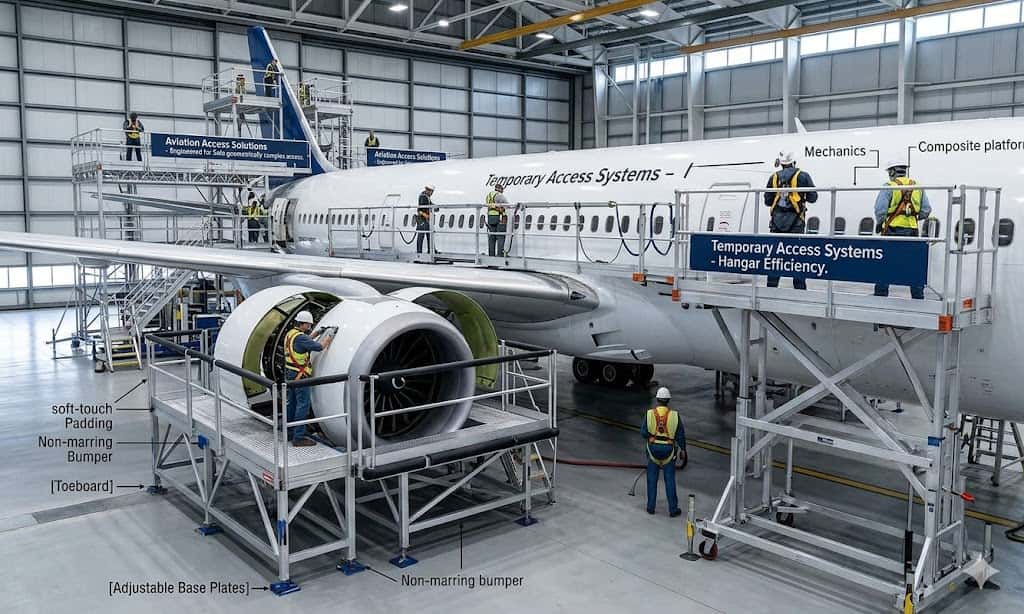
What Are Aviation Projects in the Scaffold & Access Context?
Definition: Aviation projects — in the scaffold and access context — encompass scaffold provision for commercial airports, military airfields, and aviation maintenance facilities across three primary application areas: aircraft maintenance docking scaffold — purpose-built elevated access systems that allow MRO technicians to reach all surfaces of commercial and military aircraft for inspection, repair, painting, and scheduled maintenance; airport terminal, concourse, and landside construction and renovation — construction scaffold supporting new terminal construction, gate expansion, and the renovation of operating terminals where continued airline operations and passenger flow must be maintained throughout construction; and airfield infrastructure maintenance — scaffold and access equipment for airfield lighting systems, navigation aids, control tower maintenance, and other airside infrastructure requiring access within or adjacent to the operational airfield environment. Each of these application areas operates under the FAA's regulatory framework for airport operations and safety — including specific airside access control requirements, foreign object debris (FOD) prevention programs, and height and lighting restrictions that make aviation scaffold work a distinct and specifically regulated construction environment.
The foreign object debris (FOD) hazard is the most operationally significant safety consideration specific to aviation scaffold work that has no equivalent in other construction environments. FOD — any object, fragment, or material that is out of place in the aviation environment and capable of being ingested by an aircraft engine, damaging an aircraft surface, or creating a runway or taxiway hazard — can cause catastrophic aircraft damage and incidents if a scaffold component, fastener, tool, or piece of construction debris finds its way onto an active airfield surface, taxiway, or apron area near operating aircraft. Aviation scaffold contractors must implement rigorous FOD prevention programs — systematic tool and component accounting, covered containment for loose items on airside scaffold, and structured FOD walkdown procedures before and after each work shift — that go well beyond the standard construction site housekeeping requirements described elsewhere in this resource library.
Aircraft maintenance docking — the provision of purpose-built scaffold or proprietary docking systems that allow maintenance technicians access to a specific aircraft type's fuselage, wings, tail assembly, and engine pylons — is a highly specialized application with aircraft-type-specific configuration requirements, ground clearance and stabilization demands specific to the aircraft being docked, and industry-standard certification processes administered through the aircraft manufacturer and the MRO facility's quality management system. MRO scaffold contractors typically maintain docking systems certified for specific commercial aircraft types — wide-body and narrow-body passenger aircraft each with their own docking configuration — and must follow the aircraft manufacturer's approved maintenance manual requirements for docking equipment. Through Scaffold Exchange, you can find scaffold vendors near you with aviation project experience and compare their FOD management protocols, airside access credentials, and aircraft type docking capability.
How Scaffold Is Delivered on Aviation Projects
Aviation scaffold delivery varies significantly between the three primary application areas — aircraft docking, terminal construction, and airfield infrastructure — but all share the FOD prevention and airside access control requirements that govern any scaffold work in the aviation environment.
Airside Access Authorization & FOD Training
Scaffold crews working in airside areas — within the secured perimeter of an operational airport, on the apron, taxiway, or runway environment — must complete the airport authority's airside driver training and access authorization process, receive a secure identification media (SIM) badge or equivalent airside access credential, and complete FOD awareness training specific to the aviation environment before any airside scaffold work begins. These access and training requirements apply in addition to the standard OSHA scaffold training that governs the scaffold work itself.
FOD Prevention Program Implementation
Before scaffold erection begins in or adjacent to an airside area, the FOD prevention plan for the specific work scope is established — tool tethering and accountability requirements, covered or tethered scaffold component practices, FOD walkdown procedures before and after each work shift, and the reporting and response protocol if a scaffold component or tool is lost or suspected to have migrated to an airside area. This FOD prevention program must be reviewed and approved by the airport's FOD prevention coordinator or operations authority before work begins.
Erection Under Aviation Operational Constraints
Scaffold is erected with attention to the operational constraints specific to the aviation environment — height restrictions near approach and departure paths where structures could create an FAA obstacle, lighting requirements that prevent scaffold lights from interfering with pilot visual references and navigation aids, and coordination with airport operations for any scaffold work that affects apron, taxiway, or airfield access. Terminal and concourse construction scaffold must maintain required passenger circulation, emergency egress, and airline operations throughout the construction period.
Dismantling, FOD Walkdown & Site Clearance
Scaffold dismantling in airside areas includes a structured FOD walkdown of the work area and all airside surfaces within the scaffold's influence zone before the area is reopened to aircraft operations — confirming no scaffold components, fasteners, tools, or construction debris remain that could create a FOD hazard. A formal site clearance sign-off with the airport operations authority is typically required before normal airside operations resume in the affected area.
Key Scaffold Considerations for Aviation Projects
Aviation projects combine the FOD prevention, airside access, and FAA regulatory dimensions that are entirely specific to this environment with the construction and industrial scaffold challenges of the specific structures being accessed.
Foreign Object Debris Prevention
FOD prevention is the defining safety priority of aviation scaffold work — systematic tool and component accounting, tool tethering on airside scaffold, covered containment for loose items, and structured FOD walkdown procedures before and after each shift are mandatory practices that have no equivalent in non-aviation construction environments. A single lost fastener on an active taxiway can cause tens of millions of dollars in engine damage and endanger an aircraft and its passengers.
Airside Access Control
Scaffold crews working within the secured airside perimeter of an operational airport must hold current airside access authorization — typically including airport-specific driver training, security background checks, and an issued airside credential (SIM badge or equivalent) — before any airside access is permitted. This access authorization process adds lead time to aviation project mobilization that must be planned for explicitly.
Aircraft Maintenance Docking
Aircraft maintenance docking scaffold must be configured specifically for the aircraft type being maintained — fuselage height, wing and tail geometry, engine pylon access, and ground clearance requirements vary significantly between narrow-body, wide-body, and military aircraft types, requiring docking systems certified and configured for the specific aircraft rather than a generic scaffold configuration that approximates access.
FAA Height & Obstruction Restrictions
Scaffold and temporary structures at airports are subject to FAA obstruction evaluation requirements — structures within specific distances of runways and approach paths must be assessed for their impact on navigable airspace and, above defined height thresholds, require FAA obstruction lighting and marking or operational waivers. Construction scaffold on airport projects must confirm FAA obstruction requirements for its specific location and height before erection.
Occupied Terminal Construction
Airport terminal and concourse renovation scaffold must maintain the passenger circulation, airline gate operations, and emergency egress that an operating terminal requires throughout construction — requiring construction phasing, temporary circulation routes, and scaffold configurations developed with the same occupied-building sensitivity described on the Commercial Projects and Renovation Projects industry pages, applied to the specific operational requirements of an active airline terminal.
MRO Quality Management Integration
Aircraft maintenance docking scaffold at MRO facilities operates within the facility's aviation quality management system — typically AS9100 or equivalent — which governs scaffold certification, inspection, and maintenance documentation to a standard aligned with aviation industry quality requirements rather than standard construction scaffold inspection practice. Docking scaffold documentation must satisfy the MRO facility's quality audit requirements alongside OSHA compliance obligations.
Common Aviation Project Scenarios Using Scaffold
Scaffold supports the aviation sector across the aircraft maintenance, airport construction, and airfield infrastructure applications that define this industry's access needs.
Commercial aircraft heavy maintenance docking — full-aircraft scaffold docking systems for wide-body and narrow-body aircraft C-check and D-check heavy maintenance at MRO facilities
Military aircraft maintenance docking — purpose-configured docking scaffold for fixed-wing and rotary-wing military aircraft maintenance at defense facilities
Airport terminal and concourse construction — new terminal construction and gate expansion scaffold at commercial airports
Occupied terminal renovation — phased renovation scaffold at operating airline terminals maintaining passenger flow and gate operations throughout construction
Hangar construction and maintenance — new aircraft hangar construction and hangar roof and structural maintenance scaffold
Aircraft painting and exterior coating — specialized docking scaffold for full aircraft exterior paint stripping and repainting at MRO and aircraft finishing facilities
Control tower construction and maintenance — scaffold for air traffic control tower construction and maintenance access
Airfield lighting and navigation aid maintenance — scaffold access to approach lighting, runway edge lighting, instrument landing systems, and other airfield navigational infrastructure
Aviation vs. Other Project Categories on Scaffold Exchange
Aviation scaffold work spans multiple categories in the Scaffold Exchange taxonomy while adding the FOD and airside access dimensions unique to the aviation environment.
Airport, MRO, and airfield infrastructure scaffold
- FOD prevention is the defining safety requirement with no equivalent elsewhere in this library
- Airside access authorization required for all scaffold crews in the secured perimeter
- Aircraft type-specific docking configuration for MRO applications
- FAA obstruction assessment requirements for scaffold near approach and departure paths
Business-occupied real estate
- Airport terminal construction shares occupied-building continuity demands with commercial projects
- Aviation adds airside access, FOD, and FAA regulatory dimensions beyond commercial building scope
- See the Commercial Projects industry page for the occupied-building construction framework
Public sector procurement & compliance
- Many major airports are publicly owned, bringing government procurement requirements
- Military airfields add defense facility security clearance requirements
- See the State and Government Projects industry page for public sector compliance detail
Industrial facility scaffold
- MRO facilities share the industrial maintenance scaffold demand pattern
- Aviation adds aircraft-type-specific docking and FOD requirements beyond general industrial
- See the Industrial Projects industry page for the broader industrial maintenance scope
Find Aviation Scaffold Vendors Near You
Use the Scaffold Exchange map to search by location, filter by project type, and connect directly with local scaffold vendors who have aviation industry experience, airside access credentials, FOD prevention programs, and aircraft docking capability matched to your facility's requirements.
Compliance & Site Safety Considerations
Scaffold at aviation facilities is governed by OSHA 29 CFR 1926 Subpart L for construction-phase scaffold activity and applicable general industry standards for MRO maintenance scaffold, alongside the FAA regulatory framework governing airport operations and obstruction management. FAA Advisory Circular 150/5370-2 (Operational Safety on Airports During Construction) establishes the safety standards for construction activity on operational airports — including requirements for construction staging areas, vehicle and equipment movement on the airfield, and construction activity coordination with airport operations — which scaffold contractors working on airside airport construction projects must comply with alongside standard OSHA requirements. FAA Form 7460-1 (Notice of Proposed Construction or Alteration) must be filed for structures above defined height thresholds within specific distances of airport runways, ensuring that scaffold and temporary structures are assessed for their impact on navigable airspace before erection. Aircraft maintenance docking scaffold at certificated MRO facilities operates under the FAA's Part 145 repair station regulatory framework, with docking equipment subject to the facility's quality management system requirements. Military airfield scaffold additionally involves Department of Defense security requirements for access to defense facilities. The International Air Transport Association (IATA) Ground Handling Manual and aircraft manufacturer's maintenance manuals provide additional technical guidance for aircraft docking scaffold that MRO scaffold contractors should be familiar with for the specific aircraft types they service.
- Airside access authorization — SIM badge or equivalent credential — obtained for all scaffold crew members before any airside work begins
- FOD prevention plan established, reviewed, and approved before scaffold erection begins in or adjacent to airside areas
- Tool tethering, component accounting, and FOD walkdown procedures implemented for all airside scaffold operations per the approved FOD prevention plan
- FAA Form 7460-1 filed for scaffold above applicable height thresholds within defined distances of airport runways
- FAA Advisory Circular 150/5370-2 compliance confirmed for airside construction scaffold activity coordination with airport operations
- Aircraft docking scaffold certified and configured for the specific aircraft type being maintained per the manufacturer's approved maintenance manual
- MRO facility quality management system documentation requirements satisfied for docking scaffold inspection and maintenance records
- Post-dismantling FOD walkdown completed and site clearance signed off with airport operations authority before airside area is reopened to aircraft operations
& FAA AC 150/5370-2
Scaffold Safety & Airport Construction Operations
OSHA Interpretations & Rulings →