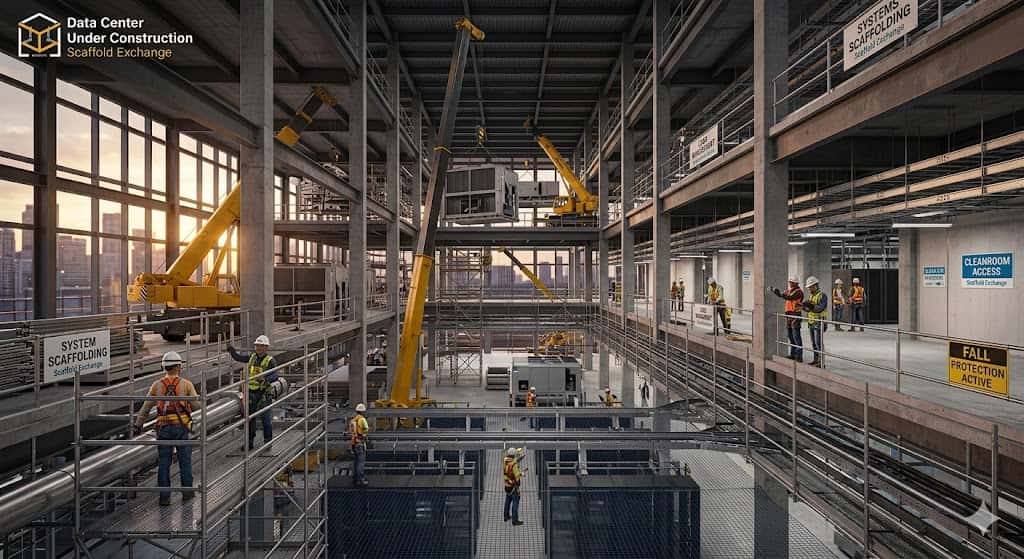
What Are Data Center Projects in the Scaffold & Access Context?
Definition: Data center projects — in the scaffold and access context — encompass scaffold provision for facilities housing computing, networking, and data storage infrastructure across three primary project types: new data center construction — hyperscale cloud provider campuses, colocation facilities, and enterprise data centers ranging from tens of thousands to millions of square feet, where scaffold supports structural steel erection, facade work, and the installation of the massive mechanical, electrical, and plumbing systems that power and cool server infrastructure; data center expansion and tenant improvement — phased buildout within existing operational data centers, where scaffold enables additional server hall capacity, raised floor extension, overhead cable tray and busway installation, and cooling system expansion while active IT infrastructure in adjacent halls continues operating without interruption; and mechanical and electrical maintenance scaffold — ongoing access to cooling systems (CRAC/CRAH units, cooling towers, chillers, and precision air handling), uninterruptible power supply (UPS) systems, switchgear, and generators that require periodic maintenance access within or adjacent to live equipment environments.
The defining operational constraint of data center scaffold work — beyond the standard construction and industrial scaffold considerations — is the requirement to protect active, revenue-generating IT infrastructure from the physical, contamination, and electrical hazards that construction and maintenance activity introduces. Server equipment is sensitive to physical shock and vibration, electrostatic discharge from personnel and equipment movement, and airborne contamination (dust and particulates) that can cause overheating and hardware failure by reducing cooling airflow efficiency. Scaffold erected adjacent to or above active server racks must prevent tool drops and falling debris from reaching the equipment below, must not generate electrostatic discharge events at levels that damage sensitive electronics, and must be kept free of the dust and particulate contamination that construction activity typically generates in quantities that are harmless in non-IT environments but consequential in data center operations.
Data center construction is one of the fastest-growing infrastructure sectors globally, driven by demand from hyperscale cloud providers, AI and machine learning workloads, and the ongoing digitization of enterprise operations — creating significant and growing scaffold demand across new construction, capacity expansion, and the maintenance of existing operational facilities. Data center projects range in scale from single-building enterprise facilities to hyperscale campus developments comparable in scale to the capital projects described on the Capital Projects industry page, with construction programs of corresponding complexity and timeline. Through Scaffold Exchange, you can find scaffold vendors near you with data center construction and maintenance experience and compare their contamination control practices, ESD awareness, and data center project track record.
How Scaffold Is Delivered on Data Center Projects
Data center scaffold delivery is shaped by the need to protect active IT infrastructure from contamination, physical damage, and electrostatic discharge throughout construction and maintenance operations in or adjacent to live server environments.
Data Center Operations Coordination & Risk Assessment
The scaffold scope is defined in coordination with the data center's critical environment manager or facilities team — identifying which areas are active versus under construction, what contamination control, vibration, and ESD requirements apply to work adjacent to live IT infrastructure, and what change management and maintenance window scheduling the data center's uptime requirements impose on construction activity. For phased expansion within an operating data center, this coordination is the most consequential planning step in the entire project.
Contamination Control Preparation
Before scaffold erection begins adjacent to active server halls or IT infrastructure, contamination control barriers — temporary construction partitions, HEPA filtration, and positive or negative pressure management — are established to physically separate the construction zone from the active IT environment, preventing dust and particulate generated during scaffold erection and subsequent construction activity from migrating into operating server halls where it could cause cooling airflow restrictions and hardware overheating.
ESD-Aware Erection in Active IT Environments
Scaffold erection in active server halls or adjacent to live IT infrastructure is performed with ESD (electrostatic discharge) awareness — personnel using ESD-appropriate footwear or grounding straps where required, scaffold components selected to avoid materials that generate significant static charge in the data center's low-humidity controlled environment, and tool and equipment movement managed to minimize static generation near sensitive equipment.
Debris Control & Infrastructure Protection
Scaffold work above active server racks, raised floor systems, or electrical distribution infrastructure requires overhead debris protection — tool tethering, covered platforms, and debris netting or sheeting — to prevent dropped tools, fasteners, or construction debris from falling onto equipment valued at millions of dollars per rack row. At dismantling, all scaffold components, fasteners, and debris are systematically accounted for before the area is returned to IT operations.
Key Scaffold Considerations for Data Center Projects
Data center scaffold work combines the contamination control discipline of cleanroom construction with the live infrastructure protection requirements unique to active IT environments.
Continuous Uptime Requirements
Commercial data centers operate under service level agreements that guarantee uptime — typically 99.999% ("five nines") for Tier IV facilities — making any construction or maintenance activity that risks disrupting active IT infrastructure an immediate commercial and contractual liability. Scaffold work adjacent to live infrastructure must be planned and executed with zero tolerance for actions that could cause IT system downtime, power disruption, or cooling failure in active server halls.
Dust & Particulate Control
Construction-generated dust and particulate can cause data center cooling airflow restrictions by accumulating on server air intake filters and heat exchangers, leading to equipment overheating and hardware failure — requiring active contamination control including construction barriers, HEPA air filtration, and regular cleaning within the construction zone throughout scaffold erection and the work performed from it.
Electrostatic Discharge Sensitivity
Data center server equipment is sensitive to electrostatic discharge events that are imperceptible to humans but damaging to microelectronics. Low-humidity data center environments (often maintained below 50% relative humidity for IT equipment thermal performance) increase static generation risk. Scaffold crews working in active IT areas should use ESD-grounding practices appropriate to the specific facility's ESD sensitivity zone requirements.
Phased Construction in Operating Facilities
Data center expansion projects are typically executed in phases — constructing and commissioning new server hall capacity while existing halls continue operating — requiring scaffold to be erected, used, and dismantled within precisely defined construction zones that are physically and electrically isolated from adjacent live infrastructure, with any crossover between construction and operations zones managed through a formal change management process.
Dense MEP Infrastructure Access
Data centers contain some of the densest mechanical, electrical, and plumbing infrastructure of any building type — overhead cable trays, busway systems, precision cooling distribution, fire suppression piping, and structural support systems — requiring scaffold configured to navigate this overhead infrastructure while providing access to the systems requiring installation or maintenance, in contrast to open structural bays typical of other construction types.
Hyperscale Construction Scale
Hyperscale data center campus construction — built by major cloud providers in multi-building campus developments exceeding a million square feet — operates at a capital project scale requiring scaffold delivery capability comparable to the large industrial and commercial capital projects described on the Capital Projects industry page, with correspondingly complex logistics, multi-contractor coordination, and scaffold fleet requirements.
Common Data Center Project Scenarios Using Scaffold
Scaffold supports data center projects across the construction, expansion, and maintenance lifecycle of hyperscale, colocation, and enterprise facilities.
New data center construction — structural steel, facade, and MEP installation scaffold for hyperscale and colocation data center new builds
Server hall buildout — scaffold for raised floor installation, overhead cable tray and busway, and ceiling-level MEP work within new or expanding server halls
Cooling system installation and maintenance — scaffold access to CRAC/CRAH units, cooling towers, chiller plant equipment, and precision air handling systems
UPS and power distribution maintenance — scaffold for uninterruptible power supply systems, switchgear, transformer, and busway maintenance in live electrical environments
Generator and fuel system maintenance — scaffold access to emergency diesel generators and associated fuel storage and distribution infrastructure
Phased tenant improvement buildout — scaffold for colocation tenant space buildout within an operating facility maintaining existing customer infrastructure
Roof and building envelope maintenance — facade and roof scaffold at operating data center facilities maintaining weather-tight envelope protection for the IT infrastructure inside
Fire suppression system installation and maintenance — scaffold for clean agent and gaseous fire suppression system installation and inspection in server halls
Data Centers vs. Other Project Categories on Scaffold Exchange
Data center scaffold shares characteristics with several categories but adds the IT infrastructure protection and uptime requirements that distinguish it from all of them.
IT infrastructure construction & maintenance scaffold
- Uptime SLA obligations make construction disruption an immediate commercial liability
- Dust, ESD, and debris protection for high-value active IT equipment is the defining constraint
- Phased construction within live operating facilities requires strict zone isolation
- Hyperscale campus construction operates at capital project scale and complexity
Contamination-controlled construction
- Shares contamination control discipline — barriers, HEPA filtration, particulate management
- Cleanrooms target ISO particle count classifications; data centers target IT equipment protection
- See the Cleanroom Services industry page for the ISO particle classification framework
Business-occupied real estate
- Data center construction shares occupied-building continuity demands with commercial projects
- Data centers add ESD, uptime, and IT infrastructure protection beyond commercial building scope
- See the Commercial Projects industry page for the occupied-building construction framework
Large-scale, multi-year planned construction
- Hyperscale data center campus construction operates at capital project scale and timeline
- See the Capital Projects industry page for the large-scale construction procurement and delivery model
Find Data Center Scaffold Vendors Near You
Use the Scaffold Exchange map to search by location, filter by project type, and connect directly with scaffold vendors who have data center construction and maintenance experience, contamination control practices, and live IT environment awareness.
Compliance & Site Safety Considerations
Scaffold at data center construction and maintenance projects is governed by OSHA 29 CFR 1926 Subpart L for construction-phase scaffold activity and applicable OSHA general industry standards for maintenance scaffold, alongside the data center operator's critical environment protection requirements, contamination control protocols, and change management framework that govern any construction or maintenance activity within the facility. Data center Tier classifications — defined by the Uptime Institute's Tier Standard for Data Center Topology — establish the redundancy and availability requirements that govern how construction and maintenance activity must be planned and executed to preserve the facility's Tier rating and uptime obligations, with higher-Tier facilities (Tier III and IV) requiring fault-tolerant design that means construction work must not create single points of failure in the facility's power or cooling infrastructure even temporarily. NFPA 75 (Standard for the Fire Protection of Information Technology Equipment) and NFPA 76 (Standard for the Fire Protection of Telecommunications Facilities) govern fire protection system requirements in data centers and telecommunications facilities, relevant to scaffold work near suppression system infrastructure and fire compartmentation boundaries. Electrical safety for scaffold work near live electrical distribution infrastructure — including high-density busway, switchgear, and UPS systems common in data center environments — is governed by NFPA 70E (Standard for Electrical Safety in the Workplace), requiring approach boundary assessment and appropriate PPE for any scaffold work in proximity to live electrical equipment. ICRA (Infection Control Risk Assessment) protocols, described in the context of healthcare facilities on other industry pages in this library, have been adopted by some data center operators to manage construction contamination risk through a structured barrier and monitoring framework analogous to their use in healthcare construction.
- Change management approval obtained from the data center operations team before scaffold erection begins in or adjacent to active IT infrastructure zones
- Contamination control barriers, HEPA filtration, and pressure management confirmed before construction begins adjacent to active server halls
- ESD awareness and grounding practices confirmed for personnel and equipment working in active IT equipment zones
- Overhead debris protection — tool tethering, covered platforms, debris sheeting — confirmed for scaffold work above active server racks and electrical distribution
- NFPA 70E electrical safety approach boundaries assessed and PPE confirmed for scaffold work near live electrical distribution infrastructure
- Uptime Institute Tier requirements confirmed — construction activity confirmed not to create single points of failure in power or cooling infrastructure
- Fire suppression system status confirmed before scaffold work adjacent to or within suppression system coverage zones — suppression system impairment procedures followed where required
- All scaffold components, fasteners, and debris accounted for and cleared before construction zone is returned to active IT infrastructure operations
& NFPA 70E
Scaffold Safety & Electrical Safety in the Workplace
OSHA Interpretations & Rulings →