
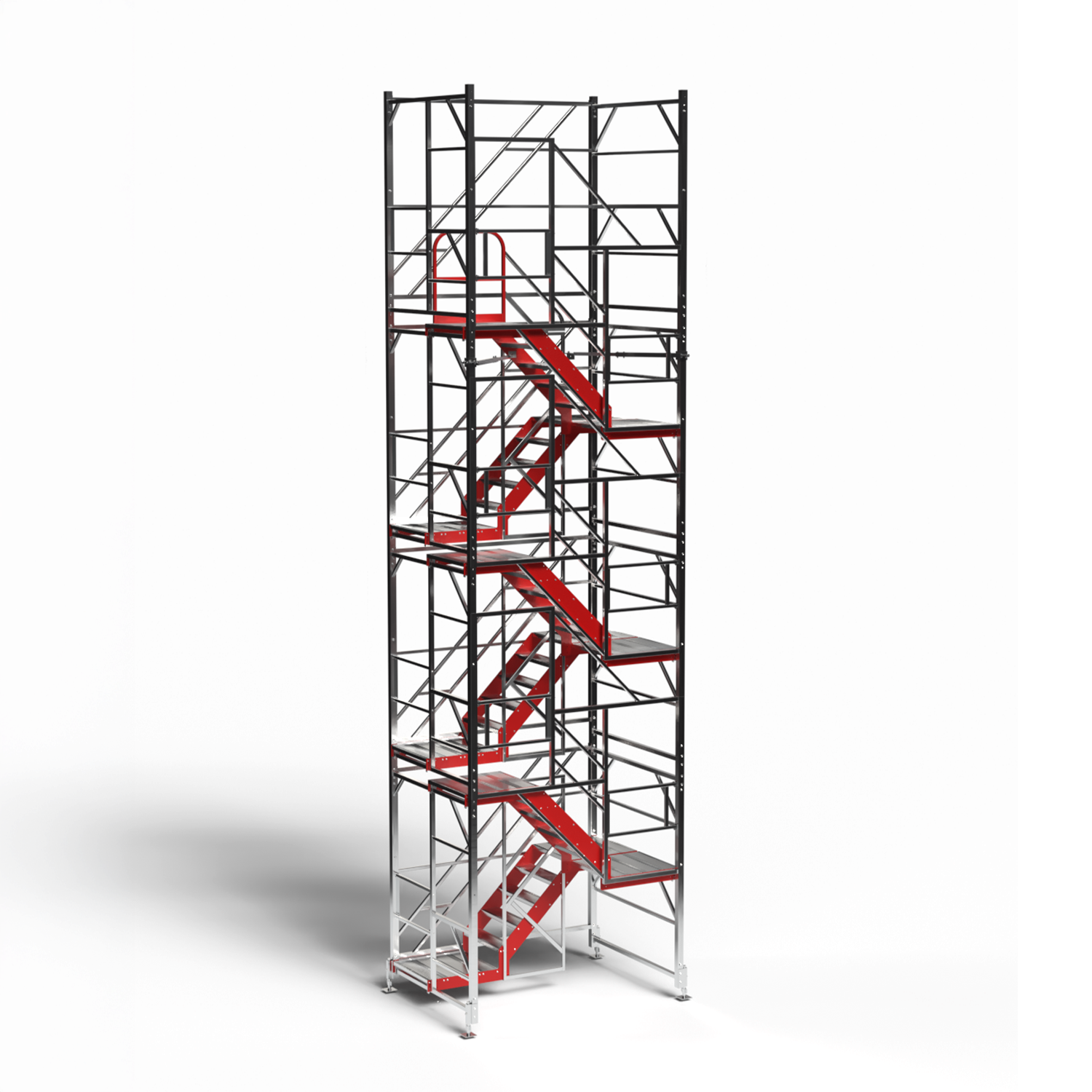
Z-Stack Stair Towers
A modular aluminum stair tower system that stacks vertically into a complete, scalable access structure — engineered to replace ladders, scaffolding, and improvised stairs with fast, repeatable, compliant vertical access. Find Z-Stack and modular stair tower vendors near you through Scaffold Exchange.
What Is a Z-Stack Stair Tower?
Definition: Z-Stack is a modular vertical stair tower system manufactured by SafeSmart Access, built from engineered aluminum box modules that join together — stacked vertically — to form a complete, scalable access structure. Each module connects with precision alignment to the next, allowing crews to build a stair tower to virtually any required height by adding modules, rather than constructing or renting a custom scaffold stair system for each project. Z-Stack is designed as a structured alternative to traditional scaffold stair systems, ladders, and improvised temporary stairs.
The system's defining advantage is speed and repeatability: a two-or-more-person crew can assemble or reposition a Z-Stack tower without the time investment of a conventional scaffold stair build, and towers can also be delivered pre-assembled or crane-installed into position as a complete unit on larger projects. Constructed from high-strength aluminum, each module is rated to support up to 1,100 pounds, with the overall system carrying a 2.5kPa weight rating and engineered to comply with OSHA standards for vertical access.
Z-Stack and similar modular stair tower systems are particularly valuable on projects where vertical access needs change repeatedly — multi-level construction where floor heights shift by project phase, drydock and shipyard work requiring safe dock-to-deck movement, and constrained footprints where traditional scaffolding is inefficient or physically intrusive. Through Scaffold Exchange, you can find vendors across the U.S. who carry Z-Stack and compatible modular stair tower systems and compare their inventory, rental rates, and availability in your area.
How Z-Stack Stair Towers Work
The modular box-stacking design is what allows Z-Stack to reach virtually any required height using the same core components, with precise alignment maintained at every joint.
Calculate the Required Height
The total vertical height needed is measured, and the number of modules required is calculated — many manufacturers provide planning tools to determine the module count for both standard and compact tower configurations.
Stack the Modules
Engineered aluminum box modules are joined together vertically with precision alignment, either assembled directly on site or pre-assembled and craned into position as a complete tower.
Connect the Finish Components
Depending on the remaining height gap to the target level, a bridge, adjustable stair section, or an additional module is added to complete the connection precisely to the exit point.
Inspect & Place Into Service
The completed tower is inspected for stability, handrail integrity, and tread compliance before crews begin using it for vertical access, material movement, or both.
Key Components of a Z-Stack System
Z-Stack achieves its broad height range and flexibility through a small set of engineered modules and finish components rather than a large catalog of custom parts.
Aluminum Box Modules
The core building block of the system. Engineered, high-strength aluminum modules that stack vertically with precision alignment, each module rated to support up to 1,100 pounds.
Integrated Stair Runs
Stair treads built into the modular box system, providing continuous vertical access through the full height of the tower without relying on separate ladder sections or fixed caged ladders.
Bridge & AdjustaStairs Finish Components
Finish pieces used to close small height gaps between the top of the stacked modules and the target exit level — a bridge section for shorter gaps, or an adjustable stair section for larger gaps before adding a full module.
Handrails & Guardrails
Integrated rail systems along stair runs and landings, engineered to meet applicable fall protection requirements for both scaffold-style and general industry stairway access.
Base Frame
The ground-level support structure the tower stacks from, providing a stable, level foundation for the full height of modules above it.
Flat-Pack / Crane Lift Configuration
Modules can be flat-packed for efficient transport and storage, or the entire tower can be assembled off-site and crane-lifted into position as a single unit, reducing on-site labor hours significantly.
Common Applications & Job Site Uses
Z-Stack and modular stair towers solve recurring vertical access challenges on projects where conditions, floor heights, or access points change throughout the job.
Multi-level construction access where floor heights change by project phase
Drydock and shipyard dock-to-deck access
Constrained footprints where conventional scaffolding is impractical
Rooftop and elevated equipment access in facility environments
Replacement of fixed or caged ladder systems
Temporary access during multistory building construction
Industrial plant maintenance and turnaround access
Long-term or large infrastructure projects requiring repeatable access
How Z-Stack Compares to Other Access Systems
Z-Stack is purpose-built as a faster, more flexible alternative to scaffold stair towers and ladders. Here is how it compares to related access equipment.
Modular aluminum stair tower
- 1,100 lbs rated per module; 2.5kPa system rating
- Builds, adjusts, and repositions faster than scaffold stairs
- Can be crane-installed fully pre-assembled
- Replaces fixed ladders and caged ladder systems
Stair access built from scaffold components
- Built from standard frame or ringlock components
- Subpart X stairway requirements apply only when used for non-scaffold access
- More labor-intensive to assemble and adjust
- Widely available from any scaffold rental vendor
Powered scaffold with full-platform travel
- Powered vertical travel for crew and materials
- Used for facade access work, not stairway egress
- Higher cost and more complex than a stair tower
- Governed by OSHA 29 CFR 1926 Subpart L
Single-rung vertical access
- No material-carrying capacity
- Requires tie-offs and careful climbing technique
- Slower and less safe for repeated, heavy-use access
- Lowest equipment cost of any access method
Find Z-Stack Stair Tower Vendors Near You
Use the Scaffold Exchange map to search by location, filter by equipment type, and connect directly with local suppliers who carry Z-Stack or compatible modular stair tower systems.
OSHA Compliance & Safety Standards
Stair tower compliance depends on how the structure is used. OSHA's stated policy is that 29 CFR 1926 Subpart X (general stairway and ladder requirements) does not apply to scaffold stair towers when used purely as access within a scaffold system, which instead falls under Subpart L, 29 CFR 1926.451(e). However, when scaffold-style stairs are used for access to locations other than scaffold platforms — such as temporary access to upper floors during multistory building construction — Subpart X requirements apply, including minimum width, handrails, uniform tread depth, and landing dimensions. Always confirm with your vendor which standard governs your specific application.
- Minimum stairway width of 22 inches under federal OSHA (24 inches under Cal/OSHA)
- Tread depth uniform within 1/4 inch for each flight of stairs
- Handrails installed per applicable Subpart L or Subpart X requirements
- Guardrail systems on ramps and walkways 6 feet or more above lower levels
- Module and system load ratings verified against the manufacturer's specifications
- Climbing scaffold frames or cross braces as a means of access strictly prohibited
- Tower positioned at safe distance from power lines per 1926.451(f)(6)
- Tower inspected by a competent person before each work shift
1926.451(e)
Subpart L — Scaffold Access & Stair Towers
OSHA Interpretations & Rulings →