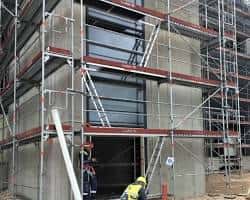
What Is STAR Frame Scaffolding by Layher?
Definition: STAR Frame Scaffolding by Layher is a prefabricated welded steel frame scaffold system in which paired vertical end frames — connected by horizontal cross braces and walk-through or ladder-access frames — form stacked bays of working platform. Unlike Layher's modular Allround system, the STAR Frame uses a traditional panel frame architecture familiar to the majority of U.S. scaffold crews, while incorporating Layher's engineering standards for dimensional consistency, component strength, and surface finish. Frames, cross braces, and accessories are designed to be fully compatible with each other across the product line, allowing rental companies to maintain a single STAR Frame inventory that can be configured into a wide range of access structures without mixing incompatible components.
The panel frame format is the dominant scaffold system in residential and light commercial construction across the United States because it is fast to erect, requires minimal training compared to modular systems, and is widely available through regional rental houses. Two workers can typically stand a STAR Frame bay — setting frames, inserting cross braces, and laying planks — without mechanical assistance, making it the default choice for contractors who need to move quickly between setups on projects with multiple access points or changing elevations.
Layher's STAR Frame product applies the company's manufacturing precision to this familiar format: consistent frame dimensions reduce the frame-to-frame tolerance issues that cause planking to rock or braces to bind in lower-quality frame systems, and the surface finish resists the corrosion that shortens the service life of standard imported frames. Through Scaffold Exchange, you can find vendors across the U.S. who stock Layher STAR Frame scaffolding and compare their inventory, rental rates, and availability in your area.
How STAR Frame Scaffolding Works
The system assembles through a straightforward stacking sequence that most scaffold crews can execute without specialized training, progressing from the foundation upward one lift at a time.
Set the Foundation
Mudsills and screw base jacks are positioned on firm, level ground at each frame location. Base jacks are adjusted to compensate for uneven terrain and to bring the first lift of frames to plumb before any frames are stood.
Stand the First Lift of Frames
Paired end frames are stood on the base jacks and braced against each other with cross braces inserted into the frame's drop-pin or hook-pin receivers, forming the first bay. Adjacent bays are added by standing additional frames and connecting them with cross braces running the length of the run.
Plank the Working Level
Scaffold planks or hook-on aluminum deck units are laid across the horizontal frame rails of the first lift, providing the initial working platform. Guardrail frames or post-and-rail assemblies are installed on the open sides and ends before workers advance to the next lift.
Stack Additional Lifts
Coupling pins are inserted into the top of the standing frames, and the next tier of frames is set directly on top, stacking vertically as each successive lift is planked, braced, and guarded before the crew advances upward.
Key Components of STAR Frame Scaffolding by Layher
STAR Frame is a complete system — every component is engineered for compatibility within the product line, eliminating the tolerance mismatches common when mixing frames from different manufacturers.
End Frames
Welded steel panel frames in standard widths (commonly 5-foot) and multiple height options, forming the primary vertical structural elements of each bay. Ladder-access and walk-through frame variants are available for built-in crew access.
Cross Braces
Diagonal steel braces that connect paired frames across the bay, providing lateral rigidity to the structure. Available in multiple lengths to match standard bay depths, with hook-pin or drop-pin ends for tool-free connection to the frame receivers.
Coupling Pins
Steel pins inserted into the top of a frame's leg tube to receive and align the leg of the next frame above, maintaining consistent vertical alignment as the scaffold is stacked lift by lift.
Planks & Deck Units
Scaffold-grade timber planks or hook-on aluminum deck panels laid across the frame's horizontal bearer rails to form the working platform. Layher-compatible deck units provide a non-slip surface and eliminate the overhang management required with timber planks.
Base Jacks & Mudsills
Screw-adjustable base jacks seated on timber mudsills that level the scaffold on uneven or soft ground, transferring vertical loads from the frame legs to a distributed bearing surface approved under OSHA foundation requirements.
Guardrail Frames & Toe Boards
Prefabricated guardrail frames or individual post-and-rail assemblies installed on open platform edges above 10 feet, combined with toe boards along the platform perimeter to prevent tools and materials from falling to lower levels.
Common Applications & Job Site Uses
STAR Frame Scaffolding is used wherever a straightforward, fast-erecting supported scaffold is needed and the work face is compatible with the standard bay widths of a panel frame system.
Residential construction and home renovation — siding, roofing, painting, and window replacement
Masonry and brickwork on low-to-mid-rise commercial buildings
Exterior plastering, stucco, and EIFS application on multi-story structures
Straight-run facade access where modular system complexity is not required
Interior ceiling and overhead MEP work in open-bay commercial or industrial spaces
Bridge maintenance and underside inspection where a simple supported platform is sufficient
Short-duration access at multiple locations across a large project site
Rental yard operations serving contractors who require widely familiar, crew-ready equipment
STAR Frame Scaffolding vs. Other Scaffolding Systems
STAR Frame occupies the high-quality end of the panel frame market — here is how it compares to the systems contractors most commonly evaluate alongside it.
Premium panel frame, welded steel
- Layher manufacturing precision with consistent frame dimensions
- Familiar panel frame format — minimal crew training required
- Full component compatibility across the STAR Frame product line
- Superior surface finish and corrosion resistance vs. standard imports
Modular rosette system, aluminum
- Greater geometric flexibility for complex or irregular structures
- Lighter components, better suited to hand-carry and frequent relocation
- Higher per-component cost; requires more crew familiarity with the system
- Preferred when shape complexity exceeds what a panel frame can accommodate
Commodity panel frame, welded steel
- Lower upfront or rental cost per frame
- Dimensional inconsistency common across mixed frame inventories
- Faster corrosion and shorter service life in outdoor environments
- Widely available but quality varies significantly by manufacturer
Traditional loose-component system
- Maximum configurability for non-standard shapes and tight spaces
- Slower erection; every connection requires a separate clamp and spanner
- Higher labor cost and greater dependence on skilled erectors
- Chosen when no panel frame configuration can fit the work face
Find STAR Frame Scaffolding Vendors Near You
Use the Scaffold Exchange map to search by location, filter by equipment type, and connect directly with local suppliers who carry Layher STAR Frame scaffolding for rent or sale.
Compliance & Site Safety Considerations
STAR Frame Scaffolding used in construction is governed by OSHA 29 CFR 1926.451, which establishes general requirements for all supported scaffold systems, including capacity, platform construction, access, fall protection, and erection and dismantling procedures. As a supported scaffold, STAR Frame must be designed and erected to support at least four times the maximum intended load. Platforms must be fully planked or decked between the front uprights and the guardrail supports, and all open sides and ends of platforms more than 10 feet above a lower level must be protected by a guardrail system. Scaffold erection and dismantling must be supervised by a competent person, and all workers who use the scaffold must receive training in accordance with OSHA 1926.454. Layher provides load capacity data for STAR Frame components; these figures should be used to verify that the intended configuration is within the rated capacity of the system before erection begins.
- Scaffold erected to support at least four times the maximum intended load
- Mudsills, base plates, and base jacks installed on a firm, level, drained foundation
- All platforms fully planked or decked with no gaps exceeding 1 inch between planks
- Guardrails, midrails, and toe boards installed on all open sides above 10 feet
- Scaffold tied or braced to the structure at required intervals per OSHA 1926.451(c)
- Coupling pins secured at all frame-to-frame connections before advancing to the next lift
- Scaffold inspected by a competent person before each work shift and after any event affecting structural integrity
- All workers trained per OSHA 1926.454 before working on or around the scaffold