What Is Ringlock Systems Scaffolding?
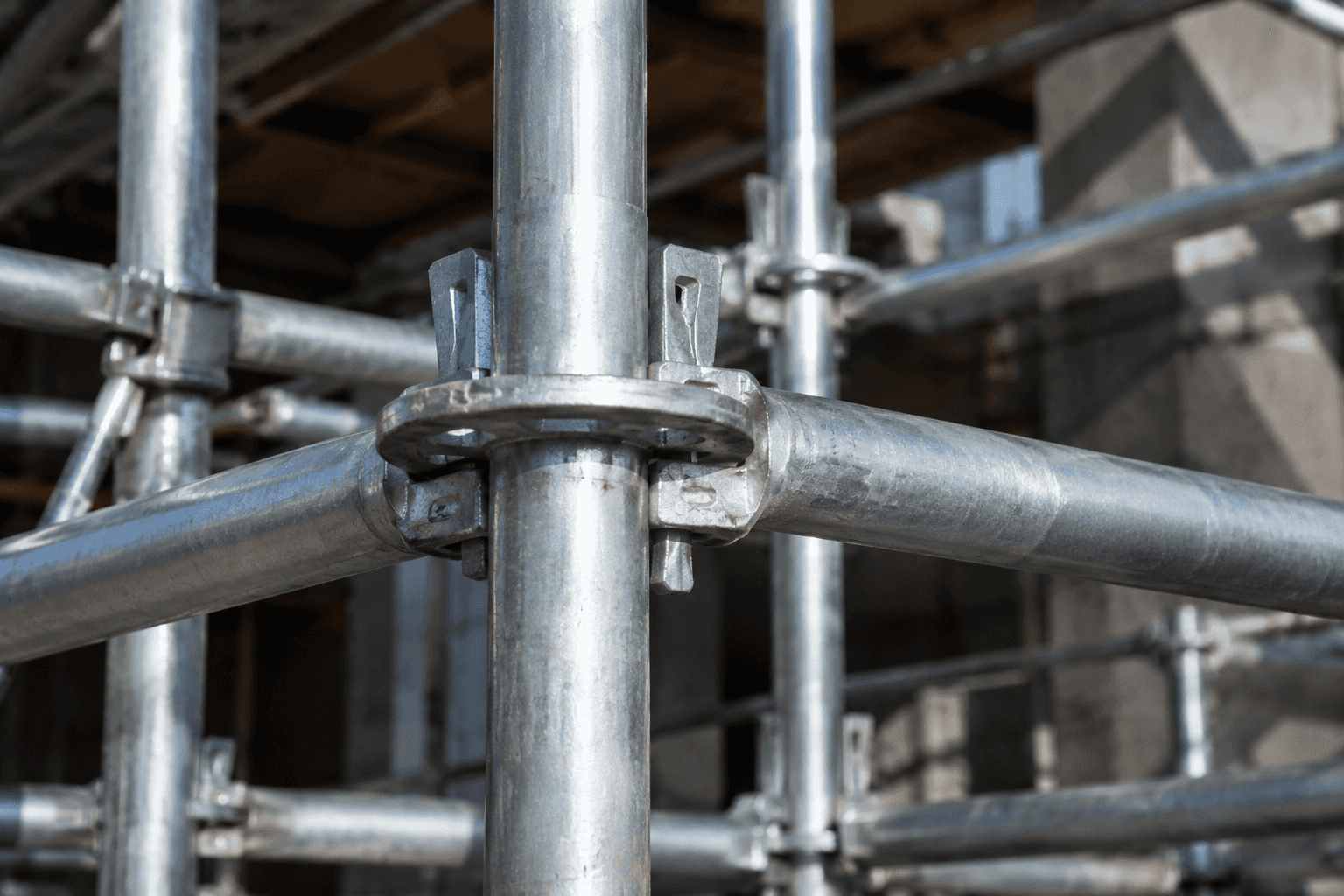
Definition: Ringlock systems scaffolding is a modular scaffold system built around vertical steel standards with 8-hole rosette rings welded at 500mm intervals. Horizontal ledgers and diagonal braces have captive wedge heads that insert into the rosette holes and lock with a single hammer blow. Each rosette can accept up to eight simultaneous connections from any direction, giving the system exceptional multi-directional flexibility without any loose bolts, nuts, or separate fittings of any kind.
Ringlock is the broadest category of rosette-based modular scaffolding — the system type that includes Wedgelock, Safway Systems, Layher Allround, Doka Ringlock, and a wide range of compatible systems. What all ringlock systems share is the same fundamental principle: an 8-hole rosette ring welded to the standard, captive wedge heads on every horizontal and diagonal member, and a gravity-assisted self-locking mechanism that creates a rigid joint under load. No bolts. No separate couplers. No loose parts on the job site.
The 8-hole rosette is the defining advantage of ringlock over other modular systems. With holes spaced 45 degrees apart in a full 360-degree plane, ringlock scaffolding can conform to curved facades, circular tanks, irregular industrial structures, and complex architectural geometries that cannot be served by fixed-geometry frame systems. Through Scaffold Exchange, you can find vendors across the U.S. who carry Ringlock system scaffolding and compare their inventory, rental rates, and availability in your area.
How Ringlock Scaffolding Works
The assembly process is identical at every node throughout the system. The captive wedge head — permanently attached to every ledger and brace — is what makes ringlock both fast and safe: there is no separate fastener to install, tighten, or forget.
Set the Standards
Vertical standards are placed on adjustable base jacks and leveled, establishing the scaffold grid at the correct bay spacing. Standards stack vertically via integral spigots welded at the top.
Insert the Wedge Heads
The captive wedge head at the end of each ledger or diagonal brace is inserted into one of the eight holes in the rosette ring. Up to eight members can be inserted at the same node simultaneously from any direction.
Drive the Wedge
A single hammer blow drives the captive wedge into its locked position. The connection actually tightens further under load — improving over time rather than loosening.
Add Decking & Edge Protection
Steel or aluminum deck planks are placed across the ledgers at each lift level. Toe boards slide behind the wedge heads without additional fixings, completing the three-part edge protection system.
Key Components of a Ringlock System
The ringlock system achieves its combination of speed and versatility through a minimal set of purpose-engineered components. Because every component uses the same rosette-and-wedge connection, there is no specialized knowledge required for each joint type.
Standards (Verticals)
Hot-dip galvanized steel uprights with 8-hole rosette rings welded every 500mm and integral spigots for vertical stacking. Available in multiple lengths from 0.5m to 4.0m.
Rosette Rings
The defining feature of all ringlock systems. An 8-hole disc welded to each standard at 500mm intervals. Holes are spaced 45 degrees apart in a full 360-degree plane, enabling connections from any direction at the same node.
Ledgers with Captive Wedge Heads
Horizontal members with permanently attached (captive) wedge heads at each end. Wedges cannot be removed or lost. Lock into rosettes with a single hammer blow and tighten further under load.
Diagonal Braces
Bay braces with captive wedge heads that connect into rosette holes at the same node as ledgers. Provide lateral stability and resistance to sway and wind loads across multi-level configurations.
Adjustable Base Jacks
Screw-type leveling jacks at the base of each standard, allowing the system to be leveled precisely on uneven, sloped, or soft ground without shimming or custom fabrication.
Steel or Aluminum Deck Planks
Prefabricated decking that locks onto the ledger tubes to form the working surface at each lift. Available in steel and aluminum; up to 80% of components are reusable across multiple projects.
Common Applications & Job Site Uses
Ringlock systems scaffolding is used across an exceptionally wide range of industries and project types. Its combination of multi-directional flexibility, high load capacity, and fast no-bolt assembly makes it the system of choice for the most demanding construction and industrial environments in the United States.
Commercial and high-rise building facade access
Industrial plant maintenance, turnarounds, and shutdowns
Curved, circular, and irregular structure access
Bridge construction, inspection, and repair
Offshore construction, shipbuilding, and marine access
Mining — underground and elevated access in harsh environments
Stair towers, birdcage scaffolds, and shoring systems
Tanks, silos, chimneys, and power generation infrastructure
Key Advantages of Ringlock Systems Scaffolding
The 8-hole rosette and captive wedge head combination delivers performance advantages that no other scaffold system category can fully match across the full range of commercial, industrial, and infrastructure applications.
8 Connections Per Node
The 8-hole rosette allows up to eight ledgers and braces to connect at the same node, spaced 45 degrees apart in a full 360-degree plane — more connection options than any other modular system.
Captive Wedges — Zero Loose Parts
Every wedge head is permanently attached to its ledger or brace. There are no separate fasteners to install, tighten, drop, or lose — on a large job site, this saves significant time and reduces safety risk.
45-Degree Angular Flexibility
With eight holes spaced 45 degrees apart, the system can be configured for straight bays, angled bays, curved facades, circular tanks, and complex geometries that fixed-geometry frame systems cannot serve.
80% Component Reusability
Hot-dip galvanized components resist corrosion and withstand repeated assembly and disassembly cycles. Up to 80% of ringlock components can be reused across multiple projects, lowering total cost of ownership.
How Ringlock Compares to Other Scaffolding Systems
Ringlock is the most capable modular system category — but other systems may be more appropriate depending on load requirements, project scale, and available vendor inventory. Here is how it compares.
Standard prefabricated panels
- Most affordable and widely available
- Fastest for routine exterior work
- Fixed geometry — cannot adapt to complex shapes
- Best for flat, regular building exteriors
Rosette-and-wedge modular system
- Same rosette-and-wedge principle as ringlock
- Typically 4–6 connections per rosette node
- Ringlock's 8-hole rosette offers more angles
- Compatible systems vary by manufacturer
Two-cup rotating lock system
- Locks up to 4 connections per node per blow
- No rosette — uses a cup-and-blade mechanism
- Fast for large-bay configurations
- Less angular flexibility than 8-hole ringlock
Proprietary ringlock-type system
- Uses same ringlock principle — 360-degree ring sets
- Ring sets spaced 21" apart (vs. 500mm/~19.7")
- Seismic qualified for critical facilities
- Proprietary — sourced from Safway vendors only
8-hole rosette modular system
- Up to 8 connections per node at 45° increments
- Captive wedge heads — zero loose parts
- Connections tighten further under load
- Up to 80% component reusability
Find Ringlock Systems Scaffolding Vendors Near You
Use the Scaffold Exchange map to search by location, filter by equipment type, and connect directly with local suppliers who carry Ringlock or compatible modular rosette scaffold systems.
OSHA Compliance & Safety Standards
Ringlock systems scaffolding used on U.S. job sites must comply with OSHA standard 29 CFR 1926.451, which governs all supported scaffold systems in construction. The captive wedge connection eliminates loose parts that can be under-tightened or left off during assembly, and connections that tighten further under load reduce the risk of joint failure on long-duration projects. Proper erection and inspection by a competent person familiar with ringlock systems is required before every shift. Always configure the system according to the manufacturer's load tables and never mix components from incompatible manufacturers.
- All captive wedge heads fully driven and inspected before loading
- Guardrails on all open sides and ends above 10 feet
- Mid-rails at the midpoint between top rail and platform surface
- Toe boards installed to prevent falling tools and materials
- Base jacks and mudsills used on all vertical standards
- System load capacity verified against manufacturer's tables before use
- Scaffold inspected by a competent person before each work shift
- Do not mix components from incompatible manufacturers or systems
1926.451
Supported Scaffolds — U.S. Construction Regulations
OSHA Interpretations & Rulings →