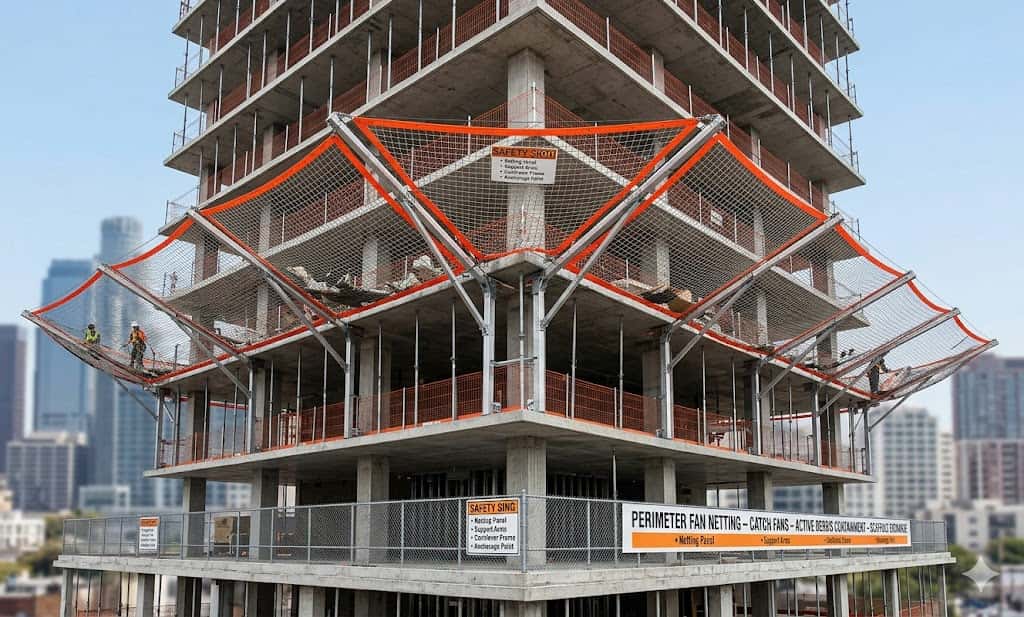
What Is Perimeter Fan Netting?
Definition: Perimeter fan netting is a falling object protection system consisting of netting panels mounted on angled outrigger brackets — commonly called fan brackets — that project outward and downward from the edge of a building floor slab, scaffold deck, or structural frame. The brackets hold the netting at an angle away from the building face, creating a fan-shaped catch plane that captures debris falling from the floor or level above and deflects it back toward the building rather than allowing it to fall freely to the street or ground below. Unlike vertical containment netting, which hangs parallel to the building face, perimeter fan netting is installed at each working level and angled outward to intercept objects that travel beyond the slab edge before they accumulate enough downward velocity to become a serious hazard at ground level.
Perimeter fan netting is most commonly associated with multi-story new construction where open floor slabs — before curtain wall or cladding installation — create an unguarded perimeter at every level from which tools, fasteners, concrete, and formwork components can fall. On a high-rise construction site, a single dropped object from an upper floor can reach lethal velocity before it reaches the street. Fan netting installed at each floor level intercepts debris as close to the source as possible, dramatically reducing the fall distance — and therefore the kinetic energy — of any object that does go over the edge, while also containing the debris within the building footprint rather than allowing it to scatter into the surrounding public space.
Perimeter fan netting is also used on renovation and facade work on occupied buildings, where slab-edge protection supplements or replaces vertical containment netting when the geometry of the work face makes a vertical net insufficient to catch debris that originates at or near the building's own floor edge. Through Scaffold Exchange, you can find vendors across the U.S. who carry perimeter fan netting systems and compare their bracket configurations, netting specifications, and availability in your area.
How Perimeter Fan Netting Works
Perimeter fan netting is installed level by level as the building rises, with each fan bracket and net panel assembly attached at the floor slab edge and advanced upward as construction progresses.
Install Fan Brackets at the Slab Edge
Angled outrigger fan brackets are bolted or clamped to the structural slab edge, floor beam, or scaffold frame at each level requiring perimeter protection. Brackets are spaced at intervals specified by the netting manufacturer — typically every 6 to 10 feet — and positioned to project the netting outward beyond the slab edge at the required angle and extension distance.
Suspend & Tension the Netting Panels
Netting panels are attached to the fan brackets and tensioned to form a continuous angled catch plane along the full perimeter of the floor level. Panel-to-panel seams are laced or clipped to eliminate gaps, and the inner edge of the netting is secured to the slab edge or scaffold frame to prevent debris from passing between the net and the building face.
Advance Netting Upward with Each New Floor
As the structure rises, a new tier of fan brackets and netting is installed at the new working floor level. Lower-level fan netting is typically retained for a specified number of floors below the active work level to catch debris that may travel horizontally before falling, in accordance with the project's falling object protection plan.
Clear Debris & Inspect Regularly
Debris accumulated in the fan netting is cleared at regular intervals before the load approaches the netting's rated capacity. The bracket connections, netting panel attachments, and seam lacing are inspected before each work shift and after high-wind or impact events. Damaged panels or bracket assemblies are replaced before work resumes on the affected level.
Key Components of Perimeter Fan Netting
Perimeter fan netting systems combine structural bracket assemblies with rated netting panels and the attachment hardware needed to create a continuous, gap-free catch plane at each floor level.
Fan Outrigger Brackets
Angled steel or aluminum bracket assemblies that bolt or clamp to the slab edge, floor beam, or scaffold frame and project the netting outward and downward from the building perimeter. Bracket angle, projection length, and spacing are specified by the manufacturer based on the required catch distance and the anticipated debris trajectory.
Impact-Rated Netting Panels
High-tensile polypropylene, polyethylene, or nylon netting panels rated to absorb the dynamic impact energy of falling objects at the design drop height. Mesh aperture size is selected to intercept the smallest debris type anticipated — fine mesh for fasteners and concrete chips, coarser mesh for larger material and formwork components.
Slab Edge Anchors & Clamps
Bolted anchor plates, cast-in anchors, or proprietary slab-edge clamp assemblies that connect the fan bracket to the building structure. Anchor capacity is verified against the combined dead load of the bracket and netting plus the dynamic impact load specified in the falling object protection plan.
Panel Lacing & Seam Hardware
High-tensile lacing cord or snap hardware joining adjacent netting panels at their seams and connecting the net border rope to the bracket tips. All seam connections are rated to at least the tensile strength of the netting panels they join, and are installed without gaps that could pass debris at panel edges.
Building Face Tie-Back
Anchor points and cord connections securing the inner edge of the fan netting to the slab edge, scaffold tube, or building structure, closing the gap between the netting and the building face and preventing debris from bypassing the net by falling in the space between the net's inner edge and the building perimeter.
Warning Signage & Exclusion Zone Barriers
Ground-level barriers and warning signage establishing a debris exclusion zone beneath the fan netting perimeter, maintaining a clear zone on the ground in the event that debris overcomes or bypasses the netting system and providing a secondary layer of public protection below the primary catch plane.
Common Applications & Job Site Uses
Perimeter fan netting is used wherever open slab edges, exposed building perimeters, or scaffold deck edges above occupied or public areas create a falling object hazard that vertical containment netting alone cannot adequately address.
Multi-story new construction with open floor slab edges before curtain wall or cladding installation
High-rise concrete and steel frame construction in urban environments with pedestrian traffic at grade
Facade renovation and recladding on occupied buildings where debris originates at the slab edge
Roofing and parapet work on mid-to-high-rise buildings above sidewalks and public spaces
Demolition of upper floors on existing structures where debris must be contained within the building footprint
Concrete formwork stripping and slab finishing where dropped components are a perimeter hazard
Exterior mechanical, electrical, and facade installation work at slab edges on occupied buildings
Projects in jurisdictions where local building codes or permits mandate perimeter fan netting on structures above a specified height
Perimeter Fan Netting vs. Other Falling Object Protection Systems
Perimeter fan netting addresses a specific falling object geometry — debris originating at or near the slab edge — that vertical netting and platform containment are not designed to intercept. Here is how it compares to the most common alternatives.
Cantilevered slab-edge catch system
- Intercepts debris at each floor level as close to the source as possible
- Angled outward to catch debris that travels beyond the slab edge
- Advances upward floor by floor with the structure as it rises
- Reduces kinetic energy of falling objects by minimizing fall distance
Vertical perimeter debris barrier
- Hangs vertically on the building face — intercepts debris traveling outward
- Does not catch debris that falls straight down at or inside the slab edge
- Better suited to facade work where debris originates at the wall face
- Often used in combination with fan netting on the same project
Ground-level overhead protection
- Protects pedestrians at street level but does not contain debris at height
- Debris reaches the walkway roof after falling the full building height
- Structural overhead canopy — heavier and costlier than netting
- Required at street level on many projects alongside fan netting above
Platform-edge debris prevention
- Prevents debris from leaving the platform — does not catch falling objects
- OSHA-required but insufficient as the sole control on multi-story open perimeters
- Does not address debris falling from above the guarded platform level
- First line of defense used in combination with fan netting, not instead of it
Find Perimeter Fan Netting Vendors Near You
Use the Scaffold Exchange map to search by location, filter by equipment type, and connect directly with local suppliers who carry perimeter fan netting systems for new construction and renovation projects.
Compliance & Site Safety Considerations
Perimeter fan netting addresses falling object hazards governed by OSHA 29 CFR 1926.502(j), which requires falling object protection for workers and members of the public below elevated construction work, and by OSHA 29 CFR 1926.502(b), which requires perimeter safety nets on construction sites where workers are exposed to falls and falling objects at the building edge. On multi-story new construction, perimeter fan netting is also closely related to the leading edge fall protection and perimeter guarding requirements of OSHA 29 CFR 1926.502(b) and the general industry obligation under 1926.502(j) to protect those below from falling objects. Fan bracket anchor connections to the slab edge or structural frame must be designed and verified by a qualified person to carry the required loads — including the dynamic impact load of a falling object — without overloading the slab edge or structural connection. Many local jurisdictions, particularly in major urban markets, have enacted their own falling object protection requirements that specify fan netting at defined floor intervals above street level as a condition of the building permit, and these local requirements should be reviewed alongside OSHA standards before finalizing the falling object protection plan for the project.
- Fan bracket anchor connections designed and verified by a qualified person before installation
- Netting panels rated to the required impact load for the anticipated debris type and fall height
- All panel seams laced with no gaps at bracket tips, seam edges, or the inner building face tie-back
- Fan netting maintained at the required number of floors below the active work level throughout construction
- Debris cleared from netting panels at regular intervals before accumulated load approaches rated capacity
- Ground-level exclusion zone established and maintained beneath the fan netting perimeter
- Netting and bracket assemblies inspected before each work shift and after high-wind or impact events
- Local jurisdiction falling object protection requirements reviewed and incorporated into the falling object protection plan