What Is Motorized Scaffolding?
Definition: Motorized scaffolding is a category of powered access equipment in which a working platform — sized and configured for construction, maintenance, or inspection work — is raised and lowered by an integrated drive system rather than being manually erected at a fixed height or climbed via a fixed ladder. The drive mechanism may be electric motor, hydraulic cylinder, or pneumatic actuator, depending on the system type, and may operate along a vertical mast, a pair of guide rails, or a rack-and-pinion track fixed to the building structure or a freestanding support frame. The defining characteristic of all motorized scaffolding is that the working height is continuously adjustable under power, without the crew having to dismantle and re-erect the platform or climb between fixed lift levels — a capability that fundamentally changes the productivity and ergonomics of work that requires frequent repositioning across a range of heights.
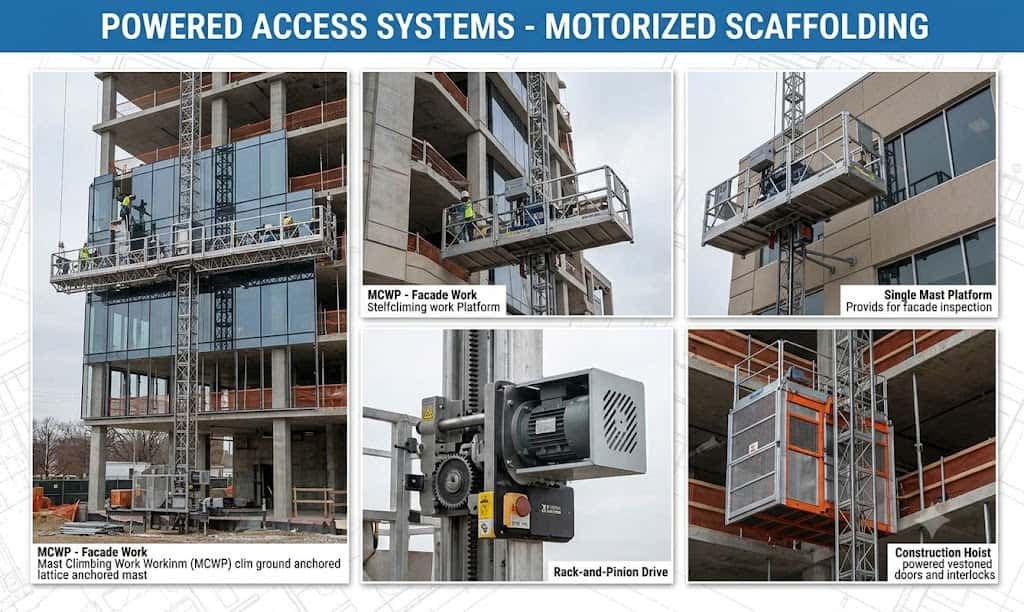
Motorized scaffolding encompasses a broad family of equipment types that share the powered vertical travel function but differ significantly in their configuration, load capacity, travel height, and the type of work they are designed to support. Mast climbing work platforms (MCWPs) are large-capacity systems that climb a freestanding or building-tied mast and can carry crews of multiple workers and heavy material loads to heights exceeding 300 feet. Construction hoists and personnel/material hoists move workers and materials vertically in an enclosed or open cage alongside a mast. Self-climbing scaffold systems use the building structure itself as a climbing guide, advancing upward as the structure rises. Each system type has a distinct application profile, load capacity, and regulatory framework.
The productivity case for motorized scaffolding over conventional fixed-height scaffold is strongest on projects where workers must perform work at continuously varying heights — facade installation, glazing, cladding, painting — or where the material load per platform cycle would require many trips on a conventional scaffold hoist. Through Scaffold Exchange, you can find vendors across the U.S. who carry motorized scaffolding systems and compare their equipment types, capacities, and availability in your area.
How Motorized Scaffolding Works
While the specifics vary by system type, all motorized scaffolding operates on the same principle: a powered drive mechanism moves the platform vertically along a fixed guide structure, with safety devices that arrest the platform automatically if the drive fails or the platform speed exceeds safe limits.
Install the Mast or Guide Structure
The vertical mast, rail, or rack system that guides and supports the climbing platform is erected alongside or attached to the building structure. Freestanding masts are anchored to the ground and tied to the building at regular intervals; building-attached systems use brackets or anchor points cast into or drilled into the structure to carry the platform loads.
Mount the Platform & Drive Assembly
The working platform — together with its integrated drive motor, drive pinion or climbing mechanism, and safety devices — is mounted onto the mast or guide rails. The platform's anti-fall safety device is tested before the system is placed in service, confirming that it will engage and arrest the platform within the required distance if the drive mechanism fails or the descent speed exceeds the rated limit.
Raise, Position & Work
Workers and materials are loaded onto the platform at ground level, and the drive system is activated to raise the platform to the required working height. The platform can be stopped, held, and repositioned at any height within the mast's range without dismantling any part of the system, allowing the crew to track the work face continuously as they move across the building elevation.
Extend the Mast & Advance with the Work
On mast climbing systems used for new construction, the mast is extended upward as the building rises — either by adding mast sections from the platform level or by a self-climbing mechanism that advances the entire system using the building structure as a climbing guide. The platform travels with the advancing mast, maintaining access to the current work level without any fixed scaffold erection below.
Key Components of Motorized Scaffolding
Motorized scaffolding systems share a common set of structural, mechanical, and safety components regardless of the specific system type, with the drive mechanism and guide structure varying by application.
Vertical Mast or Guide Rail
The fixed vertical structure along which the platform travels — either a freestanding lattice mast anchored to the ground and tied to the building, a rack-and-pinion mast section, or a pair of guide rails attached directly to the building facade. The mast or rail carries the vertical and lateral loads from the platform and transfers them to the ground or building structure through the anchor system.
Working Platform & Frame
The structural platform on which workers stand and materials are loaded, typically constructed from aluminum or steel decking on a welded frame with integrated guardrails, toe boards, and access gates. Platform widths and lengths vary significantly by system type — MCWPs can span the full width of a building facade, while single-mast platforms are narrower and suited to localized access.
Electric Drive Motor & Pinion
The powered drive mechanism — most commonly an electric motor driving a rack-and-pinion engagement with the mast — that raises and lowers the platform. Drive systems are rated for a specific load capacity and travel speed, and incorporate limit switches that prevent travel beyond the top and bottom of the mast's rated range.
Anti-Fall Safety Device
A centrifugal or electromechanical safety device mounted on the platform that automatically engages and arrests the platform within a specified distance — typically 50 to 150 mm — if the platform's descent speed exceeds the rated limit, providing the primary fall-arrest function in the event of drive failure or overspeed. Anti-fall devices are tested before initial use and at regular intervals per OSHA and manufacturer requirements.
Mast Ties & Building Anchors
Engineered tie assemblies connecting the mast to the building structure at regular height intervals, restraining the mast against lateral deflection under platform and wind loads. Tie spacing, anchor capacity, and the structural adequacy of the building attachment points are specified by the system manufacturer or a project engineer before installation.
Platform Control Panel & Interlocks
The operator control station on the platform — typically a pendant or panel with raise, lower, and emergency stop functions — combined with interlocks that prevent platform travel when access gates are open, when the platform is overloaded beyond its rated capacity, or when a fault condition is detected in the drive or safety systems.
Common Applications & Job Site Uses
Motorized scaffolding is most productive on projects where work must be performed across a wide vertical range, where heavy material loads must be delivered to height, or where the frequency of vertical repositioning makes fixed scaffold impractical or uneconomical.
High-rise curtain wall, glazing, and cladding installation requiring continuous vertical repositioning across the full facade
Concrete formwork and poured-in-place wall construction where the platform climbs with the rising structure
Exterior painting, coating, and waterproofing on tall structures where conventional scaffold erection would be cost-prohibitive
Masonry installation on mid-to-high-rise buildings where heavy brick and block loads must be delivered to the working level
Bridge and infrastructure rehabilitation requiring a powered work platform over active traffic or waterways
Chimney, tower, and silo construction and maintenance requiring access at extreme heights
Building facade inspection and maintenance on occupied high-rise buildings where permanent building maintenance units are unavailable
Worker and material vertical transport on multi-story construction sites where a construction hoist supplements or replaces internal stair access
Motorized Scaffolding vs. Other Powered & Fixed Access Systems
Motorized scaffolding covers a range of system types with distinct performance profiles — here is how the most common variants compare to each other and to the fixed scaffold alternatives contractors evaluate alongside them.
Powered vertical travel, adjustable height
- Platform raises and lowers under power — no fixed lift height
- Eliminates manual climb and fixed-height erection between levels
- Carries workers and materials in the same powered cycle
- Most productive where frequent vertical repositioning is required
High-capacity motorized facade access
- Large platform spans covering the full building width in a single setup
- High load capacity for crews and heavy materials simultaneously
- Governed by OSHA 1926.552 as a personnel hoist
- A specific type of motorized scaffolding for major facade work
Rope-suspended powered platform
- Suspended from the roof rather than climbing a ground-anchored mast
- Raises and lowers via electric hoist on wire rope or fiber rope
- Lower load capacity than mast climbing systems
- Governed by OSHA 1926.451 as a suspended scaffold
Manually erected supported access system
- Fixed height — platform must be dismantled and re-erected to change level
- No powered vertical travel — workers climb between fixed lift levels
- Lower equipment cost; higher labor cost on tall or frequently repositioned work
- Preferred for long-duration work at a consistent height range
Find Motorized Scaffolding Vendors Near You
Use the Scaffold Exchange map to search by location, filter by equipment type, and connect directly with local suppliers who carry motorized scaffolding systems for construction, renovation, and maintenance projects.
Compliance & Site Safety Considerations
Motorized scaffolding is governed by OSHA 29 CFR 1926.552, which covers material hoists, personnel hoists, and elevators used in construction — including the mast climbing work platforms and rack-and-pinion climbing systems that are the most common forms of motorized scaffolding on U.S. construction sites. OSHA 1926.552 requires that personnel hoists and mast climbing systems be designed by a registered professional engineer, that the anti-fall safety device be tested before initial use and after any incident that may have affected its function, that the rated load capacity be posted on the platform and never exceeded, and that the system be inspected by a competent person before each shift in which it is used. Motorized scaffold systems used as suspended platforms — including powered swing stages and motorized boatswain's chairs — are governed by OSHA 29 CFR 1926.451 and 1926.502 as suspended scaffolds, with their own specific requirements for rope, hoist, and tieback specifications. All motorized scaffolding installations require erection, operation, and dismantling under the supervision of a qualified person, and all workers who operate or work from motorized scaffolding must receive training specific to the system in use before operating it.
- System designed by a registered professional engineer per OSHA 1926.552
- Anti-fall safety device tested before initial use and after any incident affecting its function
- Rated load capacity posted on the platform and verified not to be exceeded before each cycle
- Mast ties installed at required intervals and anchor capacity verified before platform travel
- Limit switches tested to confirm they prevent travel beyond the top and bottom of the rated mast range
- Platform control interlocks verified — gates closed, load within rating, no fault conditions — before each use
- System inspected by a competent person before each shift and after any event affecting structural or mechanical integrity
- All operators and workers trained on the specific system in use before operating or working from the platform
1926.552
Material Hoists, Personnel Hoists & Elevators
OSHA Interpretations & Rulings →