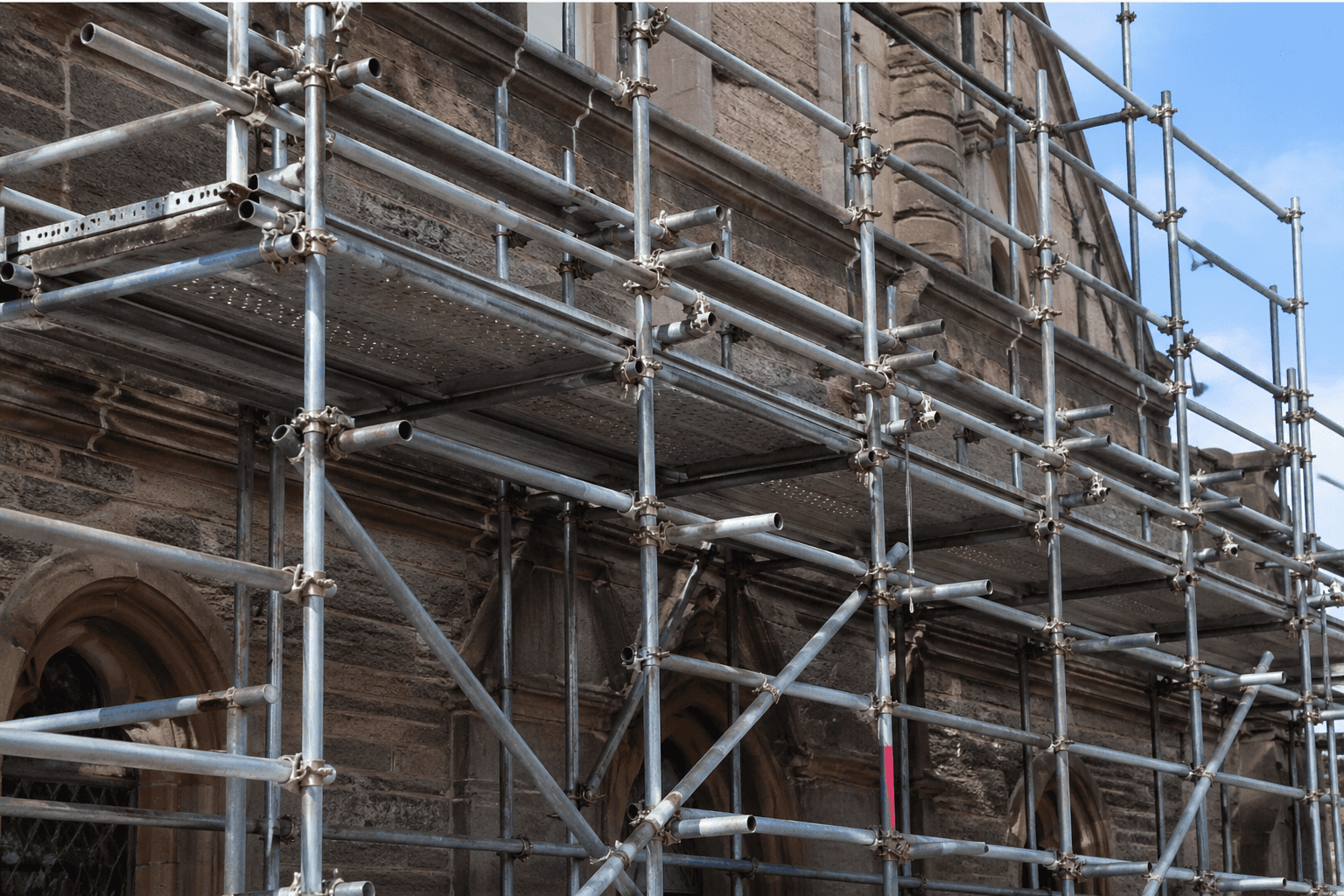
What Is Tube & Clamp Scaffolding?
Definition: Tube and clamp scaffolding — also known as tube and coupler scaffolding — is a highly flexible scaffold system made of individual steel tubes connected by swivel and fixed clamps. Unlike modular or frame systems, it can be configured in virtually any direction or angle, making it the preferred solution for complex, irregular, or non-standard structures where no other system can adapt to the geometry of the job.
The system's strength lies in its complete lack of fixed geometry. Every joint is independent, meaning tubes can intersect at any angle and extend in any direction. This makes tube and clamp scaffolding the go-to choice when a standard frame or modular system simply cannot adapt to the structure at hand — whether that's a curved facade, a multi-level industrial plant, a historic building, or a bridge undergoing maintenance.
Because it requires more skill and time to erect than prefabricated systems, tube and clamp scaffolding is typically handled by experienced scaffolding contractors. Through Scaffold Exchange, you can find qualified vendors in your area who specialize in tube and clamp systems, compare their capabilities, and connect with the right supplier for your project.
Key Components of a Tube & Clamp System
Every tube and clamp configuration is built from the same core set of components. The flexibility comes entirely from how these parts are combined on site.
Steel Tubes
The structural backbone of the system. Standard outer diameter is 1.9 inches (48.3mm). Available in various lengths and cut to suit any configuration on site.
Swivel Clamps
Allow two tubes to be joined at any angle. The defining component that gives the system its infinite flexibility and adaptability to any structural geometry.
Fixed (Right-Angle) Clamps
Join two tubes at a fixed 90-degree angle. Used for standard horizontal-to-vertical connections throughout the structure where angles are consistent.
Base Plates & Jacks
Adjustable base jacks that provide a stable, level foundation for the vertical standards on uneven, sloped, or soft terrain.
Scaffold Planks
Steel, aluminum, or timber decking spanning the ledger tubes to form the working platform at each lift level. Must be load-rated per OSHA requirements.
Sleeve Couplers
Join two tubes end-to-end to extend a standard, ledger, or brace to the exact length required for the configuration without custom fabrication.
Common Applications & Job Site Uses
Tube and clamp scaffolding is the system of choice when standard modular systems cannot accommodate a structure's shape, size, or access requirements. It is widely used across industrial, commercial, and specialized construction throughout the United States.
Industrial plants, refineries, and petrochemical facilities
Bridge maintenance, inspection, and repair
Historic building restoration and facade work
Curved or irregular building exteriors
Power stations and utility infrastructure
Shipbuilding and marine construction
Confined space and underground access structures
Concert stages, event structures, and temporary platforms
How Tube & Clamp Compares to Other Scaffolding Systems
Tube and clamp offers the most configuration flexibility of any scaffold system, but other systems are faster to erect for standard applications. Here is how it compares.
Standard prefabricated panels
- Most affordable and widely available
- Fastest setup for standard exterior work
- Fixed frame geometry — less adaptable
- Best for flat, regular building exteriors
Safway S-Style pattern frames
- Proprietary Safway pattern dimensions
- Interchangeable with existing Safway stock
- Fast prefabricated panel assembly
- Best for expanding a Safway inventory
Lightweight aluminum system
- 50–65% lighter than steel frame systems
- Faster to carry, set up, and break down
- Lower load capacity than steel
- Best for interior and residential work
Maximum configuration flexibility
- Infinitely configurable at any angle
- Ideal for curved or irregular structures
- Requires skilled labor to erect
- Longer setup time than modular systems
Modular ringlock system scaffold
- 360-degree ring sets — faster than tube & clamp
- Up to 8 connections per node point
- Seismic qualified for critical facilities
- More structured than tube & clamp
Find Tube & Clamp Scaffolding Vendors Near You
Use the Scaffold Exchange map to search by location, filter by equipment type, and connect directly with local suppliers who specialize in tube and clamp scaffolding systems.
OSHA Compliance & Safety Standards
Tube and clamp scaffolding used on U.S. job sites must comply with OSHA standard 29 CFR 1926.451, which governs all supported scaffold systems. Because tube and clamp configurations are custom-engineered on site, it is especially important that erection and inspection are performed by a competent person with experience in this system type.
- All clamps and couplers inspected for damage before use
- Guardrails on all open sides and ends above 10 feet
- Mid-rails at the midpoint between top rail and platform surface
- Toe boards installed to prevent falling objects
- Base plates and mudsills used on all vertical standards
- Scaffold inspected by a competent person before each shift
1926.451
Supported Scaffolds — U.S. Construction Regulations
OSHA Interpretations & Rulings →