What Is Frame & Brace Scaffolding?
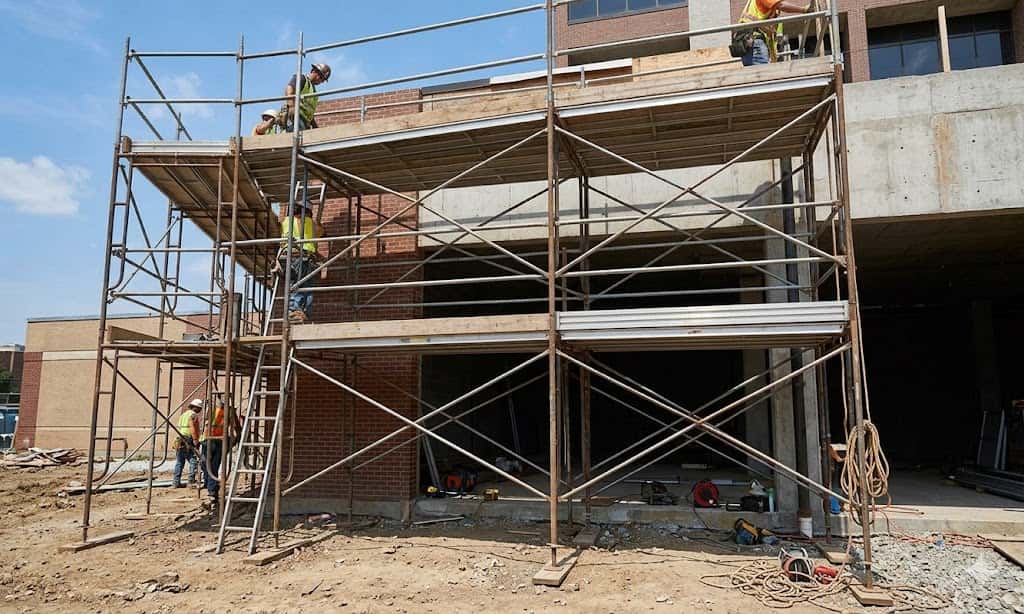
Definition: Frame and brace scaffolding is a standard, non-proprietary scaffold system built from welded end frames and diagonal cross-braces, with planks or decks spanning between frames. It provides economical, reliable access for low- and mid-rise construction work where no specific manufacturer system is required.
Unlike engineered or proprietary systems, frame and brace scaffolding uses interchangeable, industry-standard components. Walk-through frames stack vertically and lock together with cross braces, allowing crews to reach the height they need quickly. The modular design adapts around doorways, corners, and irregular surfaces with minimal reconfiguration.
Because the components are non-proprietary, they are produced by a wide range of manufacturers and carried by vendors across the country. That makes frame and brace scaffolding one of the most accessible and affordable scaffold systems available — and one of the easiest to source locally through Scaffold Exchange's vendor network.
Key Components of a Frame & Brace System
A complete frame and brace scaffolding system consists of four primary components that work together to form a safe, stable elevated platform.
Walk-Through Frames
The primary vertical structure. Standard sizes: 5-ft and 6-ft heights in 3-ft and 5-ft widths. The main load-bearing element of the system. The open center allows unobstructed movement along the scaffold at every level.
Cross Braces
Diagonal steel braces that lock adjacent frames together laterally, providing the rigidity and resistance to sway needed under load. Cross braces clip or pin into the frame legs at pre-drilled connection points.
Adjustable Base Plates
Screw-type leveling jacks at the base of each frame leg. Allow the system to be leveled on uneven, sloped, or soft ground. Required under OSHA standards for all supported scaffold systems.
Scaffold Planks
Steel, aluminum, or laminated wood decking that spans between frames to form the working platform. Must be load-rated in accordance with OSHA requirements for the intended application.
Common Applications & Job Site Uses
Frame and brace scaffolding is suitable for a broad range of residential and commercial construction tasks. Its simplicity and wide availability make it the default system across job sites throughout the United States.
Brick and block masonry on exterior walls and chimneys
Exterior painting on residential and commercial buildings
Vinyl siding and fiber cement installation
Stucco, EIFS, and exterior finish systems
Eave and fascia access for roofing crews
Window replacement and facade renovation
Tuck-pointing and building restoration
Multi-story new construction access
How Frame & Brace Compares to Other Scaffolding Systems
Frame and brace scaffolding is the most affordable and widely available system, but other systems offer distinct advantages for specific projects. Here is how it compares.
Standard non-proprietary system
- Most affordable and widely available
- Non-proprietary — sourced from any vendor
- Fastest setup for routine exterior work
- Fixed frame geometry — less adaptable
Safway S-Style pattern frames
- Proprietary Safway pattern dimensions
- 6'4" frames; 1-7/16" coupling pins at 45°
- Interchangeable with existing Safway stock
- Best when adding to a Safway inventory
Lightweight aluminum system
- 50–65% lighter than steel frame systems
- Naturally corrosion resistant
- Preferred for interior and residential work
- Higher upfront cost than steel
Maximum configuration flexibility
- Infinitely configurable at any angle
- Ideal for curved or irregular structures
- Requires skilled labor to erect
- Longer setup time than frame systems
Modular 8-hole rosette system
- 360-degree multi-directional connections
- Up to 8 connections per node point
- Higher load capacity and flexibility
- Higher cost than frame systems
Find Frame & Brace Scaffolding Vendors Near You
Use the Scaffold Exchange map to search by location, filter by equipment type, and connect directly with local suppliers who carry frame and brace scaffolding.
OSHA Compliance & Safety Standards
Frame and brace scaffolding used on U.S. construction job sites must comply with OSHA standard 29 CFR 1926.451, which governs all supported scaffold systems. When sourcing scaffolding through Scaffold Exchange, always confirm with the vendor that their equipment meets current federal and applicable state safety standards.
- Guardrails on all open sides and ends above 10 feet
- Mid-rails at the midpoint between the top rail and platform surface
- Toe boards installed to prevent falling objects
- Base plates and mudsills used on all scaffold legs
- Coupling pins fully engaged and cross braces locked before loading
- Scaffold inspected by a competent person before each work shift
- Planks fully planked with no gaps exceeding 1 inch
1926.451
Supported Scaffolds — U.S. Construction Regulations
OSHA Interpretations & Rulings →