
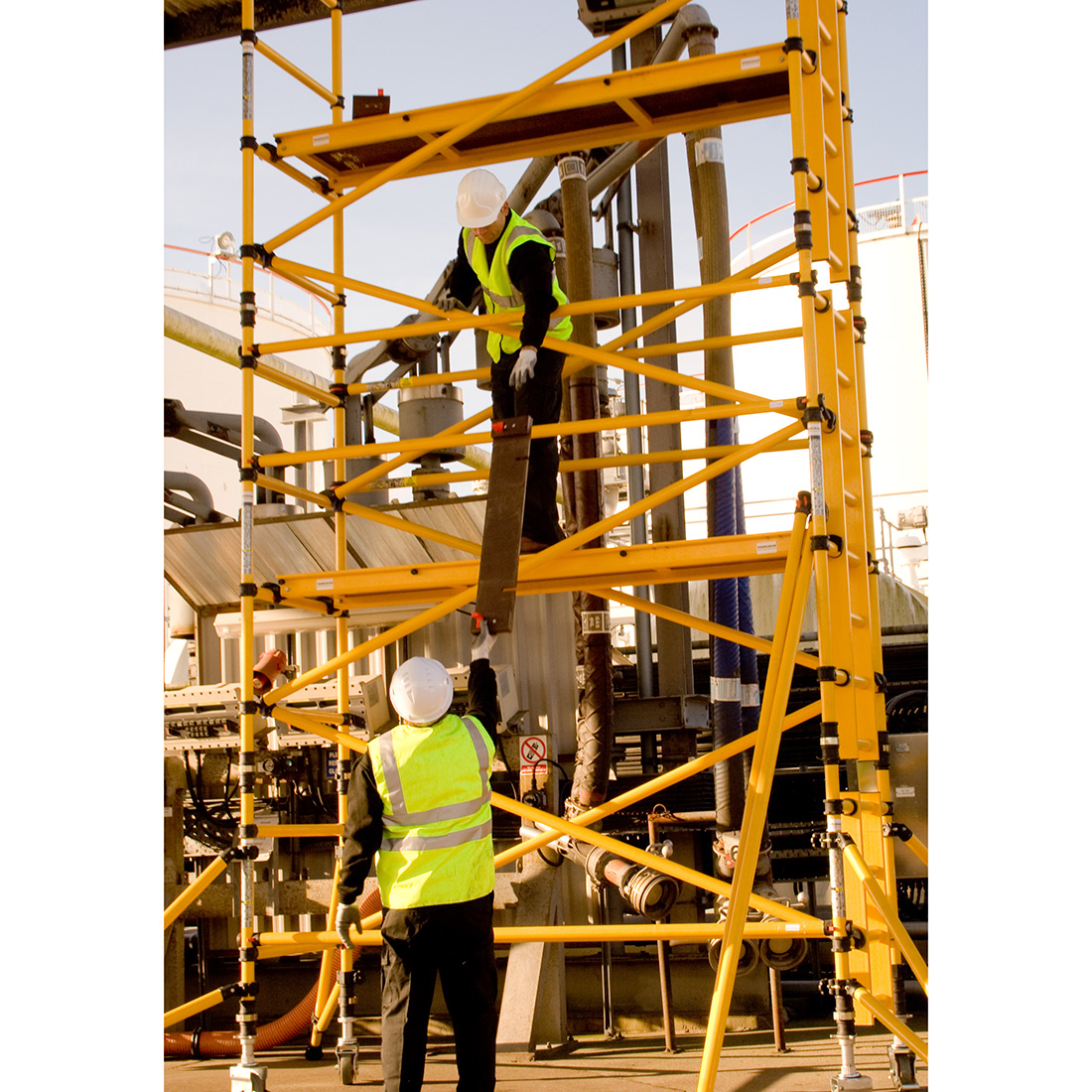
Fiberglass Access Systems
Non-conductive scaffolding and access equipment built from fiberglass-reinforced plastic — purpose-engineered for work near live electrical systems, substations, and other environments where metal scaffolding presents an unacceptable shock hazard. Find fiberglass access system vendors near you through Scaffold Exchange.
What Are Fiberglass Access Systems?
Definition: Fiberglass access systems are scaffold and access equipment manufactured from fiberglass-reinforced plastic (FRP) rather than steel or aluminum, engineered specifically for environments where the electrical conductivity of metal scaffolding presents an unacceptable safety risk. As an intrinsically non-conductive material, fiberglass eliminates the path for electrical current through the scaffold structure itself, making it the standard equipment choice for work near live power lines, inside electrical substations, and in other high-voltage or hazardous industrial environments.
Premium fiberglass access systems are manufactured and tested to specific dielectric strength ratings — some systems are tested to 100kV per foot, while certified HV/MV (high-voltage/medium-voltage) systems offer dielectric protection up to 500kV when properly maintained and certified. Zone 1 fiberglass towers are widely used across the utility industry as a platform for hot stick working — live maintenance performed on overhead power lines while the lines remain energized — a task that would be extremely dangerous on any metal-framed scaffold system.
Beyond electrical safety, fiberglass offers genuine performance advantages over metal scaffolding: it resists corrosion from moisture, chemicals, salt air, and general environmental exposure significantly better than steel, provides thermal insulation where heat transfer is undesirable, and weighs substantially less than equivalent steel components — making fiberglass tubes and components considerably easier to transport and erect. The material is also fully recyclable at the end of its service life, supporting sustainability goals on long-term industrial contracts. Through Scaffold Exchange, you can find vendors across the U.S. who carry fiberglass access systems and compare their inventory, rental rates, and availability in your area.
Key Components of a Fiberglass Access System
Fiberglass access systems mirror the component categories of conventional scaffolding, with every structural part manufactured from non-conductive FRP rather than metal.
Pultruded FRP Tubes & Standards
High-strength fiberglass-reinforced plastic profiles forming the vertical and horizontal structural members. Approximately 40 to 70 percent lighter than equivalent steel tubing, depending on the system and load rating.
Non-Conductive Couplers & Quick-Lock Pins
Joints and connectors manufactured from non-metallic materials to maintain the system's non-conductive integrity throughout, with many systems using quick-lock pins for fast modular assembly and disassembly.
Anti-Slip Fiberglass Decking
High-friction fiberglass platform decking providing secure footing for workers, manufactured to resist UV degradation and weather exposure in outdoor electrical and industrial environments.
Base Plates & Adjustable Jacks
Leveling components allowing the system to be set up on uneven substation or industrial flooring, manufactured from non-conductive materials consistent with the rest of the system.
Non-Marking Casters
Polyurethane casters with a quick-braking system on mobile fiberglass towers, allowing the structure to be repositioned quickly across a facility without leaving marks on finished floors.
Color-Coded Components
Many fiberglass systems use a unique color code on ties, hooks, and other components to simplify identification, assembly, and inventory management across a large fleet of access equipment.
Common Applications & Job Site Uses
Fiberglass access systems are specified wherever the conductivity of metal scaffolding represents a hazard that cannot be managed through clearance distances or de-energization alone.
Live-line maintenance on overhead power lines (hot stick working)
Electrical substation construction and maintenance
High-voltage and medium-voltage equipment access
Aviation and aerospace maintenance near sensitive electronics and fuel systems
Chemical plant and petrochemical facility maintenance
Power generation facility outages and turnarounds
Telecommunications tower and equipment access
Marine and offshore environments requiring corrosion-resistant access
Fiberglass Access Systems vs. Metal Scaffolding
Fiberglass occupies a specific, safety-driven niche distinct from steel or aluminum scaffold systems. Here is how it compares.
Non-conductive FRP scaffold
- Intrinsically non-conductive — eliminates shock path
- Dielectric ratings tested to 100kV/ft or higher
- Superior corrosion resistance to chemicals and moisture
- 20–30% cost premium over comparable aluminum systems
Lightweight metal frame system
- Conductive — unsuitable for live electrical work
- 50–65% lighter than steel, but still electrically live
- Naturally corrosion resistant, but not non-conductive
- Lower cost than fiberglass equivalents
Standard steel system
- Conductive — requires strict electrical clearance distances
- Most affordable and widely available
- Heaviest of the common scaffold materials
- Best for non-electrical commercial and residential work
Maximum configuration flexibility
- Typically steel — conductive unless specified in fiberglass
- Fiberglass tube and clamp variants exist for electrical use
- Infinitely configurable at any angle
- Best for complex, non-standard structures
Find Fiberglass Access System Vendors Near You
Use the Scaffold Exchange map to search by location, filter by equipment type, and connect directly with local suppliers who carry fiberglass and non-conductive access systems.
OSHA Compliance & Safety Standards
Fiberglass access systems used on U.S. job sites must comply with OSHA standard 29 CFR 1926.451, which governs all supported scaffold systems, in addition to OSHA's electrical safety requirements under 29 CFR 1926 Subpart K where work occurs near energized equipment. Non-conductive scaffolding is one of several controls used to manage electrical hazards, alongside minimum approach distances and de-energization procedures, and should be selected and certified specifically for the voltage level present at the work location. Always verify the manufacturer's dielectric rating and certification documentation matches the actual voltage exposure on site.
- Dielectric rating verified against the actual voltage present at the work location
- Manufacturer's certification and test documentation confirmed current
- Guardrails on all open sides and ends above 10 feet
- Mid-rails at the midpoint between top rail and platform surface
- Base plates and mudsills used on all vertical standards
- Minimum approach distances to energized equipment maintained per site electrical safety program
- Components inspected for cracks, UV degradation, or moisture damage before each use
- Scaffold inspected by a competent person before each work shift
1926.451
Supported Scaffolds — U.S. Construction Regulations
OSHA Interpretations & Rulings →