
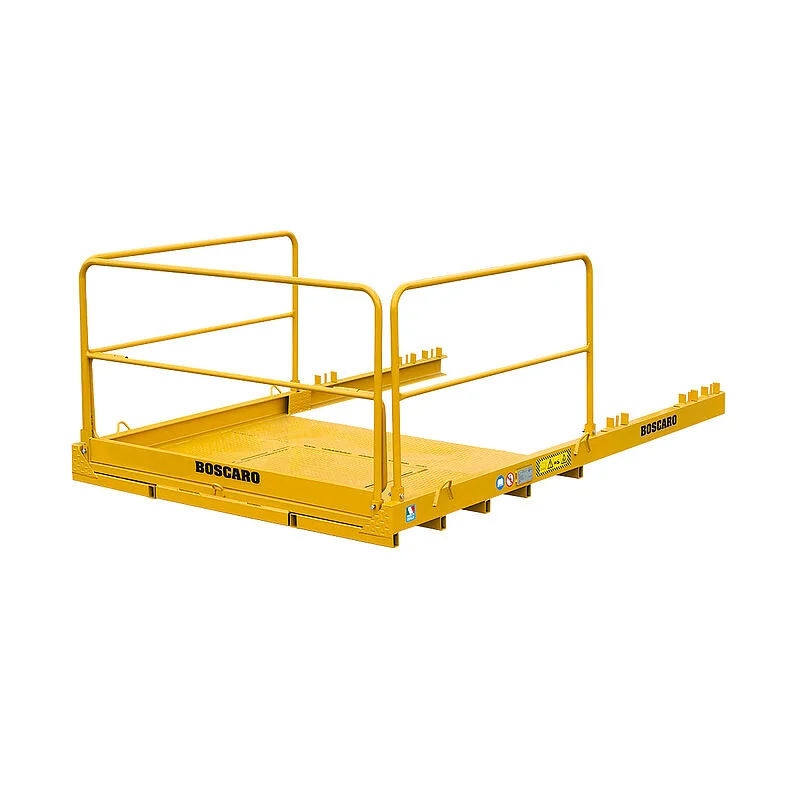
Crane Loading Platforms — Powered
A motorized, fully retractable loading platform that extends and retracts at the push of a button — reducing crane handling time, easing elevator congestion, and speeding up material flow on high-rise job sites. Find powered crane loading platform vendors near you through Scaffold Exchange.
What Is a Powered Crane Loading Platform?
Definition: A powered crane loading platform is a motorized, fully retractable platform installed at a building edge that extends to receive crane-delivered materials and retracts back against the structure when not in use — all under powered control rather than manual extension. Unlike a fixed or manually-extended loading platform, a powered system retracts and extends using an integrated motor, typically run from a standard 110V AC outlet, allowing one operator to deploy or stow the platform without manual labor or rigging at each cycle.
Powered loading platforms are purpose-built to handle larger and heavier loads than a standard construction material hoist or elevator, while installing and relocating in a fraction of the time of a fixed system — many models can be installed or moved between floors using a material hoist, tower crane, or mobile crane in about 10 minutes. Because the platform retracts flush against the building when not extended, it minimizes the structure's footprint and reduces interference with crane operations, swing radius, and adjacent work when not actively receiving a load.
The retractable "drawer" design also enables vertical stacking — multiple powered loading platforms installed at different floors, either inline or staggered, working in coordination to dramatically improve floor-to-floor material flow and reduce the time a crane spends repositioning between deliveries. By taking high-volume, heavy material deliveries off the construction elevator entirely, powered loading platforms reduce elevator congestion, improve site traffic flow, and require no specialized training to operate. Through Scaffold Exchange, you can find vendors across the U.S. who carry powered crane loading platforms and compare their inventory, rental rates, and availability in your area.
How a Powered Crane Loading Platform Works
The motorized extend/retract cycle is what separates a powered platform from a manual one — the same receiving function, but driven by a motor rather than physical labor at every cycle.
Install & Anchor the Platform Body
The platform's fixed housing is positioned and anchored to the building structure at the designated material receiving level, typically installed using a material hoist, tower crane, or mobile crane.
Power the Platform
The unit is connected to a standard 110V AC power outlet, requiring no specialized electrical infrastructure beyond what's typically already available on an active construction site.
Extend to Receive the Load
The operator extends the platform under motorized power to its full reach — commonly 10 to 12 feet of extension on standard models — positioning the deck to receive the crane-delivered material.
Retract After Unloading
Once materials are moved off the deck and into the building, the platform retracts back against the structure under power, minimizing its footprint and clearing the area for crane operations or adjacent work.
Key Components of a Powered Loading Platform
Powered loading platforms add a motorized extension system to the same core structural and fall protection components found on manual loading platforms.
Electric Drive Motor
The motorized system that extends and retracts the platform deck. Runs on standard 110V AC power, requiring no specialized site electrical infrastructure to operate.
Retractable Platform Deck
A galvanized, anti-slip chequer plate deck — typically 6mm steel — that telescopes or slides out from the fixed housing to its full extension, then retracts back flush against the building.
Fixed Housing & Anchorage
The stationary portion of the system, anchored to the building structure, that houses the retraction mechanism and provides the structural base the deck extends and retracts from.
Enclosed Safety Railing
Full enclosure railing around the platform's working area, maintaining fall protection compliance whether the deck is extended for loading or retracted into the building.
Self-Leveling Ramp
A built-in, adjustable self-leveling ramp on premium models, providing a smooth transition for wheeled material handling equipment moving on and off the platform deck.
Integrated Lifting Points
Pre-designed lifting lugs and forklift pockets allowing the entire unit to be relocated quickly between floors or job sites using available hoisting or crane equipment.
Common Applications & Job Site Uses
Powered loading platforms are particularly valuable on high-volume, high-rise projects where material flow speed and crane efficiency directly affect the project schedule.
High-rise residential and commercial construction with heavy material volume
Multi-floor projects requiring repeated, frequent material deliveries
Sites where construction elevator capacity is a bottleneck
Vertically stacked logistics across multiple active floors simultaneously
Concrete frame and rectangular or round high-rise structures
Demolition sites requiring temporary, relocatable material staging
Tight urban sites where crane time is at a premium
Projects requiring minimal platform footprint when not actively loading
Powered vs. Manual Crane Loading Platforms
Powered and manual loading platforms serve the same core function — a safe crane material receiving point — but differ in deployment speed, footprint, and operating cost.
Motorized retractable platform
- Extends and retracts under powered control
- One operator, no manual rigging at each cycle
- Minimal footprint when retracted
- Runs on standard 110V AC power
Cantilevered crane receiving platform
- Fixed or manually extended/retracted
- No electrical power or motor required
- Lower equipment cost than a powered system
- Best for lower-frequency material delivery needs
Powered vertical transport
- Powered car travels a fixed tower between floors
- Moves materials continuously, not just receives them
- Often used together with loading platforms
- Governed by OSHA 29 CFR 1926.552
Powered scaffold with full-platform travel
- Powered platform travels the mast for facade access
- Used for working at a fixed location, not material receiving
- Classified as a supported scaffold, not a loading platform
- Governed by OSHA 29 CFR 1926 Subpart L
Find Powered Crane Loading Platform Vendors Near You
Use the Scaffold Exchange map to search by location, filter by equipment type, and connect directly with local suppliers who carry powered, retractable crane loading platforms.
OSHA Compliance & Safety Standards
Powered crane loading platforms used on U.S. construction job sites are governed by OSHA's general fall protection requirements under 29 CFR 1926 Subpart M, in addition to applicable crane operation standards under 29 CFR 1926 Subpart CC where a crane is used to deliver materials to the platform. As a powered system, the electric drive motor and retraction mechanism must also comply with the manufacturer's electrical and mechanical specifications, and must be maintained and inspected in addition to the structural and fall protection checks required of any loading platform. Retractable platforms are generally treated as temporary works and must be designed, installed, and used per the project's engineered temporary works procedure.
- Platform housing anchored per the manufacturer's engineered design
- Electric drive motor and power connection inspected and maintained per manufacturer specifications
- Platform rated to carry at least 2 times its safe working load
- Enclosed safety railing intact and inspected whether the deck is extended or retracted
- Only one retractable platform extended at a time unless exclusion zones are established
- Lifting points and forklift pockets verified before relocating the unit
- Maximum load capacity posted and clearly visible at the platform
- Platform inspected by a competent person before each use
1926 Subpart M
Fall Protection & Crane Operation, U.S. Construction Regulations
OSHA Interpretations & Rulings →