
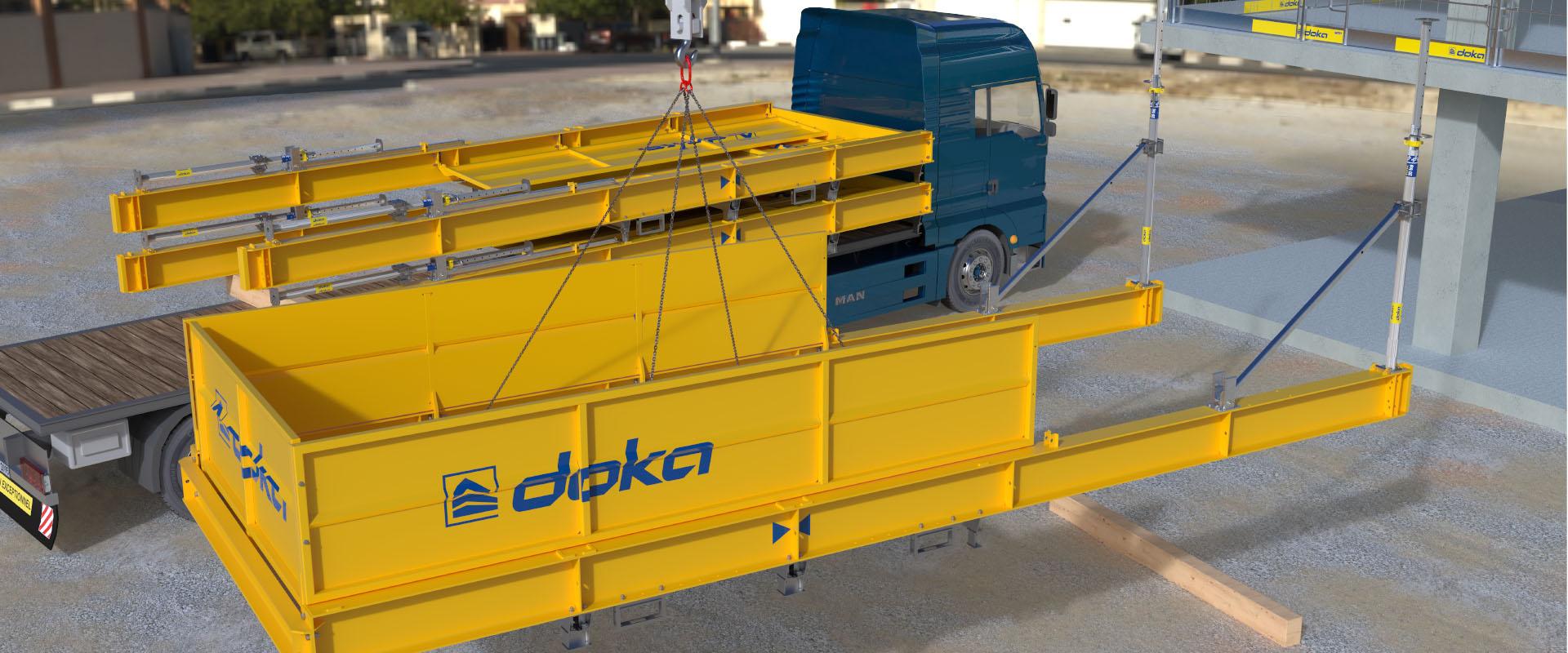
Crane Loading Platforms — Manual
A cantilevered platform mounted at a building edge that creates a safe, protected landing area for crane-delivered materials — letting crews receive, stage, and move loads into the structure without exposure to a fall hazard. Find manual crane loading platform vendors near you through Scaffold Exchange.
What Is a Manual Crane Loading Platform?
Definition: A manual crane loading platform is a cantilevered or edge-mounted steel platform installed at a building's perimeter to provide a safe, fall-protected landing area where crane-lifted materials — pallets of block, formwork, rebar, scaffolding components, tools — can be set down, staged, and moved into the structure. Unlike a powered hoist or material elevator, a manual loading platform does not move loads vertically itself; it serves as the receiving point where the crane delivers the load, and workers handle the material manually from that point into the building.
Loading platforms are typically cantilevered out from the building edge or a scaffold structure, anchored either through the floor slab or via slab-to-slab pressure clamping, and rated for a specific maximum service load — commonly up to 5,000 kg on premium systems. Most arrive pre-assembled and are positioned in place by crane in a fraction of the time a site-built equivalent would take, then anchored, inspected, and put into service the same day. Many systems also offer vertical stacking capability, allowing multiple loading platforms to be installed at different floor levels simultaneously to keep pace with a high-rise project's material flow.
Because the platform sits at an open building edge with a crane actively delivering loads above and around it, loading platform design and use is governed by strict fall protection, structural, and signage requirements. Solid side panels, inward-opening landing gates with positive stops, and posted load capacity signage are standard features on a compliant system. Through Scaffold Exchange, you can find vendors across the U.S. who carry manual crane loading platforms and compare their inventory, rental rates, and availability in your area.
How a Manual Crane Loading Platform Works
The platform's role is to provide a stable, enclosed receiving point at height — the crane does the lifting, the platform provides the safe landing zone, and the crew manually handles the material from there.
Anchor the Platform
The platform is positioned by crane and anchored to the structure — either through the floor slab using a universal clamping system, or via slab-to-slab pressure fit — at the designated material receiving level.
Verify Structural Capacity
The supporting structure and the platform's telescopic props or cantilever supports are confirmed to handle the rated load, with lifting lugs and props tested to their specified safety factors before the platform is loaded.
Crane Delivers the Load
The crane lifts and lowers materials onto the platform deck through the open landing edge, while the inward-opening gate remains closed and secured except during active loading.
Stage & Move Materials Inside
Once the load is landed and the crane disengages, the gate is opened under controlled conditions and crew manually move or roll the materials from the platform into the building.
Key Components of a Manual Crane Loading Platform
A compliant loading platform combines a load-rated structural deck with specific fall protection and material-handling features required for its position at an open building edge.
Steel Platform Deck
A structural steel deck, often a chequered plate surface for traction, rated for a specific maximum service load — commonly up to 5,000 kg on premium pre-engineered systems.
Universal Clamping / Slab Anchorage
The connection system securing the platform to the building structure, either anchored directly through the slab or via a slab-to-slab pressure-fit clamping system, depending on the platform design.
Telescopic Props & Lifting Lugs
Structural support components engineered to specific safety factors — lifting lugs typically tested to 2.5x safe working load, telescopic props tested to 4x safe working load.
Solid Side Panels
Fixed solid panels at least 1 meter high on the sides of the platform, extending at least 300mm inside the building edge with no gap through which a person or material could fall.
Inward-Opening Landing Gate
A gate at the landing edge that opens inward only, fitted with a positive stop and restraining chains to prevent the gate from swinging beyond the platform edge during loading operations.
Posted Load Capacity Signage
Signage stating the platform's maximum uniformly distributed load and maximum point load, in characters at least 100mm high, clearly visible at the platform for crew and crane operator reference.
Common Applications & Job Site Uses
Manual crane loading platforms are essential on any multi-story project where materials must be lifted by crane and brought safely into the building at height.
High-rise residential and commercial construction material delivery
Formwork and scaffolding material staging at upper floors
Rebar, block, and bulk masonry material receiving
Equipment and tool delivery to elevated work areas
Vertically stacked logistics on tall multi-story builds
Glazing and curtain wall panel material handling
Mechanical, electrical, and plumbing equipment delivery
Phased material logistics where floor-by-floor delivery is required
Manual Crane Loading Platforms vs. Other Material Handling Equipment
Loading platforms work alongside, not instead of, other vertical material handling equipment on a job site. Here is how they compare.
Cantilevered crane receiving platform
- Receives crane-delivered loads at the building edge
- Up to 5,000 kg rated capacity on premium systems
- Pre-assembled and crane-installed in place quickly
- No powered vertical movement of its own
Powered vertical transport
- Powered car or platform travels a fixed tower
- Moves materials between levels continuously
- Governed by OSHA 29 CFR 1926.552
- Often used together with loading platforms
Powered scaffold with full-platform travel
- Powered platform travels the mast for facade access
- Used for working at a fixed location, not material receiving
- Classified as a supported scaffold, not a loading platform
- Governed by OSHA 29 CFR 1926 Subpart L
Prefabricated modular guardrail
- General-purpose edge fall protection
- Not rated or designed for crane load receiving
- Used elsewhere on the same building edges
- Lower cost than an engineered loading platform
Find Manual Crane Loading Platform Vendors Near You
Use the Scaffold Exchange map to search by location, filter by equipment type, and connect directly with local suppliers who carry crane loading platforms.
OSHA Compliance & Safety Standards
Manual crane loading platforms used on U.S. construction job sites are governed by OSHA's general fall protection requirements under 29 CFR 1926 Subpart M, in addition to applicable crane operation standards under 29 CFR 1926 Subpart CC where a crane is used to deliver loads to the platform. Loading platforms are generally treated as temporary works and must be designed, installed, inspected, and used according to the project's engineered temporary works procedure and rated load limits. Installers should hold appropriate rigging or scaffolding competency credentials, and platform extension or retraction (on retractable models) should be approved by a designated competent person.
- Platform anchored per the manufacturer's engineered clamping or slab-anchorage design
- Lifting lugs and telescopic props verified to their tested safety factors before use
- Solid side panels at least 1 meter high with no gap to the building edge
- Landing gate opens inward only, with a positive stop and restraining chains
- Maximum UDL and point load posted in characters at least 100mm high
- Platform landing flush with the floor slab or fitted with a suitable ramp
- Only one retractable platform extended at a time unless exclusion zones are established
- Platform inspected by a competent person before each use
1926 Subpart M
Fall Protection & Crane Operation, U.S. Construction Regulations
OSHA Interpretations & Rulings →