
NEW VS. USED SCAFFOLD: WHICH OPTION FITS YOUR PROJECT?
Buying new scaffold can provide access to current equipment, defined specifications and a predictable supply route. Buying used scaffold can provide another route to acquiring equipment, particularly where suitable inventory is already available. But new is not automatically better, and used is not automatically cheaper.
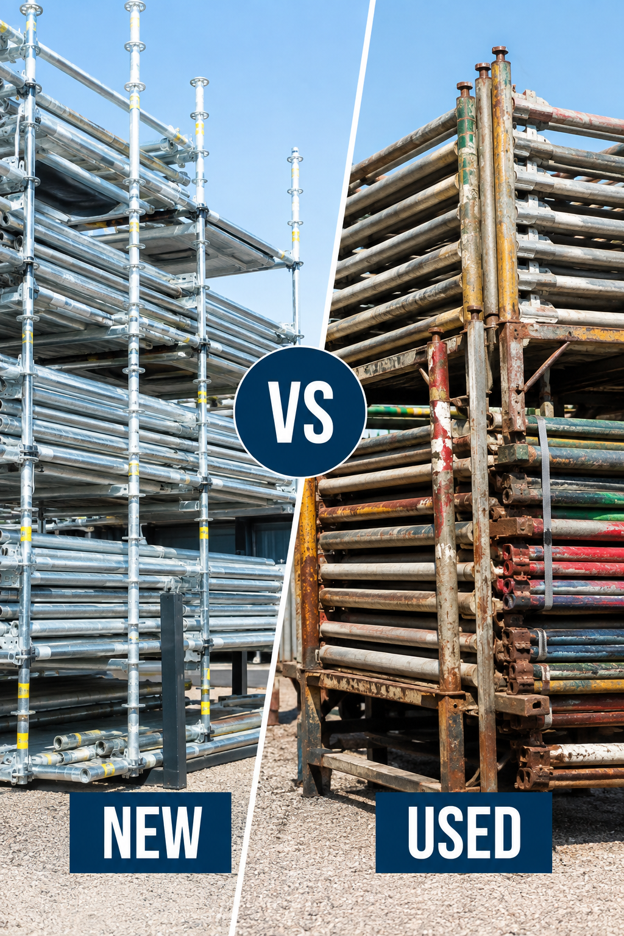
Buying new scaffold can provide access to current equipment, defined specifications and a predictable supply route. Buying used scaffold can provide another route to acquiring equipment, particularly where suitable inventory is already available.
But new is not automatically better, and used is not automatically cheaper.
The more useful procurement question is:
Which option best fits the project's technical requirements, timing, quantity, condition, utilisation and total acquisition cost?
1. START WITH THE PROJECT, NOT THE PRICE
The equipment decision should begin with the intended application.
Before comparing prices, consider the required configuration, loading, access, stability, quantity, system requirements and manufacturer specifications.
OSHA requires scaffolds to be designed by a qualified person and constructed and loaded according to that design. Scaffold components must also meet applicable requirements for strength, construction and use.
Are we choosing the equipment that fits the project, or choosing a project solution around the equipment we happen to find?
The application should drive the procurement decision.
2. CONDITION MATTERS WHEN BUYING USED
A used scaffold purchase requires more than confirming that equipment is available.
The condition of the actual equipment should be established, including any visible damage, deformation, corrosion, missing components or other defects that could affect its suitability.
OSHA requires scaffold components to be inspected for visible defects before each work shift and after occurrences that could affect structural integrity. Damaged or weakened components must be repaired, replaced, adequately braced or removed from service as required.
That means age alone does not provide the engineering answer.
A well-maintained used component may be a sensible procurement option, while a damaged or unsuitable component may not be.
The condition and suitability of the actual equipment must therefore be established before it is put into service.
3. COMPATIBILITY CANNOT BE ASSUMED
Whether equipment is new or used, compatibility remains an important engineering consideration.
Components manufactured by different manufacturers should not simply be intermixed because they appear to fit.
Where components from different manufacturers are used together, they must fit without force and the resulting scaffold must maintain its structural integrity. Any modification intended to permit intermixing must also be properly assessed.
Physical fit is not proof of engineering compatibility.
The buyer should consider the complete intended configuration, rather than whether individual components can simply be connected.
Does the equipment merely connect, or is the complete configuration suitable for the intended application?
4. AVAILABILITY AND LEAD TIME MATTER
A new equipment order may be appropriate when a project requires a specific configuration, quantity or specification that needs to be sourced.
Used equipment can be attractive when suitable inventory is already available and can satisfy the project's requirements.
But availability should be assessed carefully.
What is actually available?
In what quantity?
In what condition?
Where is it located?
When can it be delivered?
A lower purchase price does not necessarily create better value if the equipment requires extensive sourcing, missing components, refurbishment or additional transportation.
Likewise, paying more for new equipment does not automatically create better value if a significant proportion of the equipment will remain idle after the project.
5. COMPARE THE TOTAL ACQUISITION COST
The decision should not stop at the advertised purchase price.
Consider:
Equipment price
Missing components
Inspection and evaluation
Repairs or refurbishment
Transportation
Storage and handling
Procurement time and effort
Expected utilisation
Future project requirements
The real question is not:
“Which option has the lower purchase price?”
It is:
“After acquisition, preparation, logistics and utilisation are considered, which option delivers the better value for the actual project?”
That is the procurement question worth answering.
6. THINK BEYOND THE FIRST PROJECT
Scaffold is an equipment asset, not simply a one-project expense.
If equipment is likely to be used repeatedly across future projects, a higher initial investment may make commercial sense.
If the requirement is short-term, highly specific or temporary, suitable used equipment may offer a different economic proposition.
This is where utilisation becomes important.
How often will the equipment actually work after it is purchased?
An asset that spends most of its life in storage still carries capital, storage, handling and maintenance implications.
The stronger procurement decision considers not only what the equipment costs to acquire, but also how effectively it can be put to work.
THE ENGINEERING CHECK
There is no universal answer that says new scaffold is always the better choice.
There is also no universal answer that says used scaffold is always the more economical choice.
The stronger decision comes from evaluating:
APPLICATION.
CONDITION.
COMPATIBILITY.
COMPLETENESS.
AVAILABILITY.
LEAD TIME.
TOTAL ACQUISITION COST.
UTILISATION.
FUTURE REQUIREMENTS.
A suitable used-equipment lot can be a sensible procurement option when its condition, compatibility, quantity and intended application have been properly evaluated.
Likewise, new equipment may make more sense when the project requires specific equipment, quantities, specifications or availability that suitable used inventory cannot satisfy.
The objective is not simply to buy scaffold.
It is to acquire the right equipment for the work, at a cost that makes both engineering and commercial sense.
QUESTIONS BUYERS SHOULD ASK
Before choosing between new and used scaffold, ask:
What equipment does the project actually require?
What condition is the used equipment in?
Are all required components included?
Are the components compatible with the intended configuration?
What quantity is available, and when can it be delivered?
What inspection, repair or refurbishment may be required?
What is the total acquisition cost after transportation and preparation?
How frequently will the equipment be used after this project?
Could suitable inventory already be available elsewhere in the market?
EXPLORE CURRENT SCAFFOLD EQUIPMENT
Once the project requirements are clear, the next step is finding equipment that matches them.
Scaffold Exchange provides a marketplace focused on connecting buyers and sellers of scaffolding equipment, making it a useful place to explore current equipment opportunities and available inventory.
The best choice is not simply new or used.
It is the equipment that meets the project's requirements, can be properly evaluated, is available when needed, and makes engineering and commercial sense.
If both options can meet the project's requirements, which one makes the stronger engineering and commercial case?